If you have traded a Solana token in the past four years, you have almost certainly touched Raydium without realizing it. Jupiter may have routed your order, Phantom may have signed it, but the liquidity that filled it likely sat inside a Raydium pool. That is the quiet power of this protocol.
It is not the flashiest interface in DeFi, and it does not spend millions on marketing. It simply holds some of the deepest liquidity on the fastest high-throughput chain in crypto.
This Raydium Swap review is built for traders who care about execution quality, not hype. I have spent over a decade watching DEXs rise, fork, and fade. Raydium is different because it survived the collapse of its original infrastructure partner, rebuilt its model, and then defended its market share against a vertical competitor that tried to cut it out of the token launch pipeline entirely.
Below, I break down what Raydium Swap actually does, how it makes money, where it falls short, and what the data says about its native RAY token.
What Raydium Swap Is and Why It Deserves Your Attention
Raydium is a Solana-native decentralized exchange that launched in February 2021 as the chain’s first hybrid automated market maker. The original design combined constant-product liquidity pools with Serum’s central limit order book, which gave traders an experience closer to a centralized exchange while remaining fully on-chain. Serum is gone, but the architectural DNA remains.
Today, Raydium runs classic AMM V4 pools, concentrated liquidity market maker (CLMM) pools, and its own token launchpad called LaunchLab.
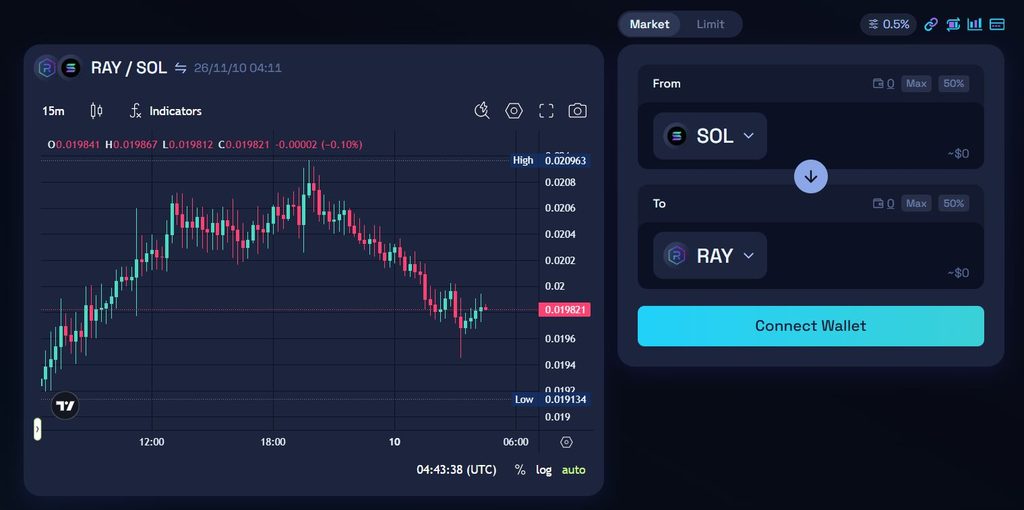
The reason this matters to anyone swapping tokens is simple: liquidity depth determines execution quality. A deep pool means less slippage on large orders. Raydium consistently ranks as the deepest DEX on Solana by deposits, with pool liquidity that has hovered around $800 million to $1 billion depending on the market cycle.
For traders moving size, that depth is not a nice-to-have. It is the difference between a clean fill and a painful one.
From Serum Integration to Solana’s Liquidity Backbone
Raydium’s history explains why it behaves the way it does today. The protocol launched in February 2021 with 555 million RAY tokens created at genesis, positioned as the liquidity layer that would feed Serum’s order book. For a brief period, it looked like the Serum-Raydium combination would define Solana DeFi. Then FTX collapsed in late 2022, and Serum collapsed with it.
Raydium did not disappear. It rebuilt around its own AMM infrastructure and kept operating.
That survival matters because it proved the protocol could function without a centralized benefactor. The next major shock came in March 2025, when Pump.fun launched its own DEX called PumpSwap and stopped migrating graduating tokens to Raydium. Historically, up to 83% of Raydium’s daily volume had come from Pump.fun graduations.
That flow dropped to a band of 7% to 35% almost overnight. Raydium responded in April 2025 by launching LaunchLab, its own bonding-curve launchpad, which became its top revenue driver within a single quarter before cooling sharply in Q4 2025 as memecoin activity normalized.
The lesson here is not that Raydium is invincible. It is that the protocol has repeatedly adapted its product mix to survive structural changes in Solana’s trading landscape. For users, that adaptability is a positive signal. It means the venue is not a one-trick pony waiting for a single narrative to return.
How Raydium Swap Works?
Raydium gives traders two primary pool types, and understanding the difference will directly affect your fees and slippage.
AMM V4 pools use the classic constant-product formula (x multiplied by y equals k). Liquidity is spread across all prices, and the fee is fixed at 0.25%. Of that fee, 84% goes to liquidity providers, 12% funds open-market RAY buybacks, and 4% goes to the treasury.
These pools are simple and passive, which makes them suitable for long-tail assets and stable pairs.
CLMM pools are the concentrated liquidity workhorse. Liquidity providers choose a price range, and capital is concentrated where trading actually happens. CLMM pools represented nearly 95% of Raydium’s Q4 2025 trading volume while holding only 18% of TVL, which tells you how much more capital-efficient they are than classic pools.
The trade-off is active management and ff the price exits the chosen range, the position stops earning fees and becomes exposed to impermanent loss.
The swap flow itself is straightforward but worth understanding because every cost attaches to a step. The front end selects a route, quotes against pool reserves, applies your slippage tolerance, adds a priority fee for Solana block space, and settles the trade. On a deep SOL/USDC pool, execution is clean.
On a freshly launched token with a few thousand dollars in liquidity, execution is poor no matter how polished the interface looks. That is a market-structure reality, not a Raydium-specific flaw, but it is the single most important thing to internalize before swapping obscure assets.
Users and Real Traction:
Raydium’s headline metrics tell a story of scale punctuated by cyclicality.
Cumulative trading volume on the protocol passed $1 trillion in May 2026, the same month RAY was listed by both Robinhood and Revolut. In 2024 alone, Raydium processed over $530 billion in volume, and in 2025 it processed approximately $642 billion.
As of mid-2026, the protocol held roughly $996 million in total value locked and processed about $4.2 billion in 30-day swap volume, generating around $87 million in annualized fees.
Market share has been equally instructive. In Q4 2025, Raydium captured 50.06% of Solana DEX trading volume, up from 48.89% in the prior quarter. That is a dominant position by any measure, but it came during a period of contraction. Total Q4 2025 volume fell 69.95% year over year, and monthly active users dropped to 5.60 million from a much higher peak. By Q1 2026, reported monthly active users were around 3.3 million, and third-party trackers later showed 30-day active user counts in the 550,000 range depending on the methodology used.
The variance is a reminder that “active users” is not a standardized metric in DeFi, but the directional signal is clear: Raydium’s user base expands violently during memecoin manias and contracts when speculation cools.
What has not contracted is Raydium’s role as a settlement venue for other applications. Jupiter, the leading Solana aggregator, routes more than half of its orders into Raydium pools. That means even traders who never open raydium.io are still relying on its liquidity. Raydium has also become the dominant venue for tokenized equity assets issued through xStocks, capturing $805.2 million, or 80.5%, of that flow over a 30-day period.
That is a meaningful diversification signal beyond memecoins.
Why Traders Choose Raydium Over Aggregators and DEXs
Raydium’s unique selling proposition is not a single feature. It is a combination of three advantages that are difficult to replicate simultaneously.
- Hybrid liquidity depth. The protocol’s legacy as an AMM-plus-order-book venue gave it a liquidity moat that newer DEXs have struggled to match. When Jupiter needs to fill a large order, Raydium is often the deepest route.
- LaunchLab and AcceleRaytor. Raydium does not just trade tokens; it helps create them. LaunchLab lets anyone launch a token with a customizable bonding curve and no migration fee, graduating to a Raydium AMM pool once it raises 85 SOL. AcceleRaytor, the curated launch arm, gives RAY stakers allocation access to vetted projects. This creates a flywheel where new assets are born and traded on the same venue.
- Fee-to-buyback tokenomics. Raydium routes a portion of every fee stream into open-market RAY purchases. AMM V4 fees send 12% to buybacks, and LaunchLab sends 25% of its 1% launch fee to buybacks. By late August 2026, cumulative buybacks had exceeded 30% of RAY’s circulating supply, a genuinely deflationary mechanism that ties token value to protocol usage rather than emissions.
That combination matters because it aligns the interests of traders, liquidity providers, and token holders. Traders get depth, LPs get fees, and RAY holders get supply reduction funded by real activity. The caveat is that the flywheel is cyclical. When volume stops, buyback pressure stops with it.
Why Raydium Matters for Solana Itself
It is easy to review Raydium as a standalone product and miss its systemic importance. Solana’s value proposition is fast, cheap transactions, but fast cheap transactions are useless without somewhere to trade. Raydium provides the deepest liquidity layer on the chain, which in turn makes Solana attractive to aggregators, market makers, and token issuers.
When Jupiter routes an order through Raydium, it is not doing Raydium a favor. It is relying on infrastructure that makes Solana’s DeFi stack function.
Raydium also matters for token issuance. LaunchLab’s graduation pipeline gives new projects a path from bonding curve to liquid market without leaving the Solana ecosystem. The debut graduation rate was only 1.14%, which is a sobering statistic for anyone tempted to treat launchpad tokens as investments.
But for the ecosystem, the existence of a functioning launch-to-liquidity pipeline is more important than the success rate of individual tokens. It keeps activity on-chain and gives creators a permissionless way to reach traders.
Real User Feedback
Public sentiment on Raydium is sharply divided, and any honest review has to confront that divide.
On Trustpilot, raydium.io holds a “Bad” rating of 1.3 out of 5 across 45 reviews. The complaints are consistent and serious. Users report failed transactions during congestion, funds lost to slippage or scam tokens, and a support system that is effectively unreachable. One reviewer described losing about $34,000 on a Raydium Perp position due to what they called an oracle price spike error, and claimed support refused to help. Another warned that the swap “allows rug pulls 40 times a day” and that there is no way to contact the team when things go wrong.
On Reddit, the tone is more balanced but still cautious. Long-term Solana users praise Raydium for low fees and deep liquidity, with one early user describing it as a core part of their Solana workflow alongside Jupiter. Another thread noted that launching a token directly on Raydium can be more costly than u
sing Pump.fun, but it “can also solidify market trust and transparency” for projects with an existing community. Technical users frequently mention that manual swaps on both Raydium and Jupiter during congestion can become “a donation to the network” if priority fees and slippage are not set correctly.
The pattern is clear. Raydium’s protocol-level liquidity is respected, but its front-end reliability and user support draw heavy criticism. That is a familiar trade-off in DeFi: the deepest liquidity often sits on interfaces that were built for function, not for customer service. Traders who understand this can use Raydium effectively. Traders who expect a Coinbase-like support experience will be disappointed.
Explore More: How to Swap Solana to USDT
The RAY Token:
RAY is not a governance-only token with vague promises. Its value accrual is mechanically linked to protocol activity through buybacks, and that link has produced both dramatic upside and painful cyclicality.
In September 2026, RAY jumped 12% in 24 hours as Raydium’s revenue surged, and broader reports noted a 105% weekly gain at one point, driven by a spike in StonkFun trading volume that overwhelmed the fee system. The buyback mechanism means that high-volume periods directly reduce circulating supply.
By late August 2026, more than 30% of the circulating supply had been repurchased using protocol fees, a figure that exceeds $190 million in cumulative buybacks.
But the same mechanism works in reverse. In Q4 2025, LaunchLab revenue fell 88% quarter over quarter as memecoin activity cooled, and total protocol revenue dropped 73% to $7.3 million. RAY is best understood as a leveraged bet on Solana trading intensity, not a stable yield asset. When swaps are busy and launches are flowing, buybacks provide a powerful tailwind. When the cycle turns, the buyback flow slows, and the token has no structural price floor beyond market demand.
The listings on Robinhood and Revolut in May 2026 expanded access to RAY for retail investors, which is a meaningful legitimacy signal. But access does not change the underlying cyclicality. Anyone holding RAY should watch protocol fee volume and LaunchLab graduation rates as leading indicators, not just the token chart.
Raydium vs Jupiter vs Orca:
| Dimension | Raydium | Jupiter | Orca |
|---|---|---|---|
| Core role | AMM plus order-book heritage, deep liquidity venue | DEX aggregator and smart routing hub | User-friendly AMM with Whirlpools |
| Typical user | Market makers, DeFi veterans, project teams | Price seekers, arbitrageurs, high-frequency traders | Newcomers, retail LPs, experience-focused users |
| Liquidity model | AMM V4, CLMM, CPMM | Routes across multiple DEXs | Concentrated liquidity Whirlpools |
| Key strength | Deepest Solana pools and launchpad integration | Best-price routing across venues | Simplicity and capital efficiency |
Source: Gate Learn comparison of Solana DEX ecosystems. Raydium is the liquidity layer. Jupiter is the routing layer. Orca is the experience layer. They compete, but they also depend on each other.
Risks You Should Be Aware Of:
Raydium’s strengths are real, but so are its risks. The protocol is single-chain by design, which means any Solana outage or congestion event directly affects usability. It has been audited by Kudelski and MadShield, but two audits is a modest count compared with multi-chain blue chips, and the protocol’s upgrade keys and admin controls are not extensively documented.
Meme-token concentration creates shallow liquidity for many assets, which amplifies slippage and impermanent loss for LPs during downturns.
The user-experience complaints on Trustpilot should also be treated as a genuine risk factor. A deep pool does not protect you if the interface freezes during a volatile moment, or if you sign a transaction without verifying the mint address. Raydium is a tool for informed users, not a managed service.
Frequently Asked Questions About Raydium Swap
01 Is Raydium Swap safe to use?
Raydium’s core smart contracts have reportedly undergone security audits by Kudelski and MadShield. However, audits do not eliminate all risks, and DeFi platforms cannot be considered completely safe. Users may still face risks from Solana network congestion, malicious or counterfeit tokens, phishing websites, smart contract vulnerabilities, and front-end issues. Before swapping, verify the token’s contract address, check the transaction details, and set an appropriate slippage limit. Never connect your wallet to an unverified website.
02 How does Raydium make money, and how does that affect RAY holders?
Raydium generates revenue through trading and token-launch-related fees. Under the stated AMM V4 fee structure, the 0.25% swap fee is allocated as follows: 84% to liquidity providers, 12% to RAY buybacks, and 4% to the treasury. LaunchLab charges a stated 1% fee, with 25% directed towards RAY buybacks. These buybacks can create demand for RAY and reduce the circulating supply when tokens are purchased and removed from circulation. However, buybacks do not guarantee price appreciation, and their impact depends on trading volume, token supply dynamics, and broader market conditions.
03 What is the difference between Raydium and Jupiter?
Jupiter is primarily a DEX aggregator that searches multiple liquidity sources to find efficient swap routes, while Raydium is a decentralised exchange and liquidity provider with its own trading pools on Solana. Jupiter can route transactions through Raydium pools when they offer suitable liquidity or pricing. The two platforms therefore serve different but complementary roles in the Solana DeFi ecosystem. Jupiter helps users find trading routes, while Raydium provides liquidity through its pools and trading infrastructure.
04 Can I use Raydium to launch a token?
Yes. Raydium’s LaunchLab allows users to create tokens using configurable bonding curves. According to the supplied launch parameters, a token can graduate to a Raydium AMM pool after reaching a fundraising threshold of 85 SOL, with no separate migration fee stated. However, launching a token does not guarantee liquidity, trading activity, or market success. The reported debut graduation rate of 1.14% highlights how few projects successfully reach graduation. Most newly launched tokens are highly speculative and carry substantial risks for both creators and buyers.
Raydium Swap is not the easiest DEX to use, and it is not the most polished interface in crypto. But if execution quality and liquidity depth are your priorities, it remains one of the most important venues on Solana. The protocol has survived infrastructure collapse, competitive attack, and cyclical downturns, and it has built a fee-to-buyback mechanism that gives RAY a direct link to real activity.
Use it with clear eyes about its support limitations and cyclical exposure, and it will serve you well. Ignore those risks, and the same depth that fills your order can also leave you exposed when the cycle turns.