ShibaSwap is the decentralized exchange built specifically for the Shiba Inu community, and it remains one of the most important infrastructure pieces for SHIB holders. If you own SHIB, BONE, or LEASH, understanding how ShibaSwap works is not optional, it is essential.
This review breaks down its fees, supported assets, community sentiment, and whether it still deserves your attention in 2026.
What Is ShibaSwap?
ShibaSwap is an automated market maker (AMM) decentralized exchange built on the Ethereum blockchain. It launched on July 6, 2021, as a fork of SushiSwap, which itself was adapted from Uniswap . The core mission was straightforward: transform SHIB from a pure meme coin into an asset with real utility.
Unlike centralized exchanges, ShibaSwap lets you trade directly from your wallet without creating an account or submitting personal information. You connect, swap, and disconnect.
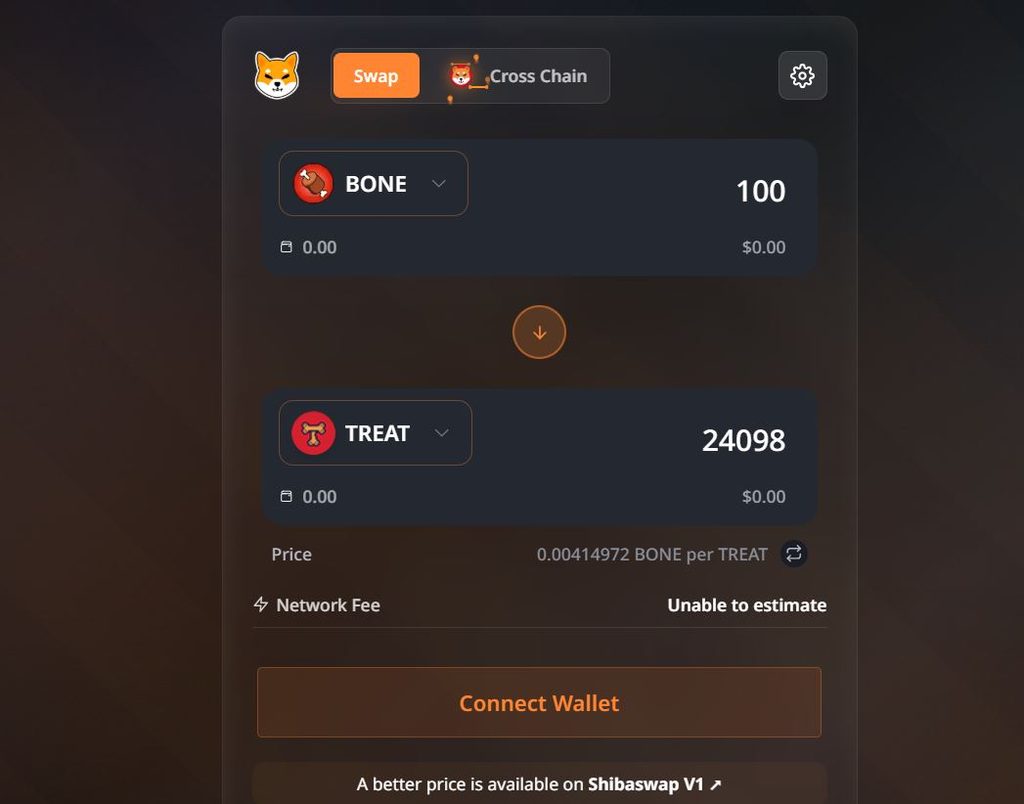
The platform operates under the governance of Doggy DAO, a community-driven organization where BONE holders vote on protocol decisions .
ShibaSwap’s importance goes beyond trading. It serves as the central hub for the entire Shiba Inu ecosystem, offering staking, liquidity mining, yield farming, and NFT trading through Shiboshis .
For the SHIB Army, it is the primary destination for putting their tokens to work.
Supported Assets and Ecosystem Tokens
ShibaSwap supports hundreds of ERC-20 tokens, with over 230 markets available . However, the platform is fundamentally built around the “SHIB tri-factor”, three tokens that form the backbone of the ecosystem.
| Token | Symbol | Role | Supply |
|---|---|---|---|
| Shiba Inu | SHIB | Primary meme coin and trading asset | 1 quadrillion (initial) |
| Bone ShibaSwap | BONE | Governance token; also used as gas on Shibarium | 250 million |
| Doge Killer | LEASH | Limited-supply store of value token | 107,647 |
SHIB is the most widely available token in the ecosystem and can be swapped against any ERC-20 asset . BONE grants holders voting rights proportional to their holdings and is designed to serve as the gas token for Shibarium, the Layer 2 solution .
LEASH has an extremely limited supply, making it highly volatile and often used as a hedging instrument within the community .
The most popular trading pairs on ShibaSwap include ETH/VEMP, BONE/ETH, and SHIB/ETH . For SHIB holders specifically, liquidity depth on ShibaSwap is exceptional. You typically will not suffer from high slippage when trading large amounts of SHIB here because the community concentrates its volume on this platform .
ShibaSwap Fees Explained
Understanding ShibaSwap’s fee structure is critical before you execute any transaction. There are two distinct cost components: swap fees and gas fees.
Swap Fees (Liquidity Provider Fees)
ShibaSwap v1 charges a flat 0.3% fee on all token swaps . This fee is not collected by the platform. Instead, it is immediately deposited into liquidity reserves, increasing the value of LP tokens for all liquidity providers proportional to their share . You do not need to claim these rewards manually, they compound automatically over time.
ShibaSwap v2 introduced multiple fee tiers: 0.05%, 0.3%, and 1%, depending on the pool . This allows traders to access better pricing for stablecoin pairs while maintaining higher fees for exotic assets. However, the classic v1 interface remains the most commonly used for SHIB ecosystem trades.
There is currently no protocol fee on ShibaSwap v1. The documentation leaves open the possibility of a 0.05% protocol fee being activated in the future, which would represent one-sixth of the total swap fee and reduce LP earnings slightly .
Gas Fees (Ethereum Network Costs)
ShibaSwap operates primarily on Ethereum, which means you pay Ethereum gas fees for every transaction. These fees go to the network validators, not ShibaSwap. Gas costs fluctuate dramatically based on network congestion. During peak periods, a single swap can cost $20 to $50 or more.
During quieter times, it may drop to a few dollars.
Some sources indicate ShibaSwap also operates on Binance Smart Chain for certain operations, where transaction fees are significantly lower, typically $0.50 to $2.00 per swap .
However, the primary and most liquid version remains on Ethereum. If you are a smaller trader, timing your ShibaSwap activity during low-gas periods is essential.
The community frequently advises: “Use ShibaSwap when gas fees are low” .
Key Features Beyond Swapping
ShibaSwap is not just a token exchange. It offers a suite of yield-generating tools that attract long-term SHIB holders.
DIG (Liquidity Provision)
DIG allows you to provide liquidity to pools by depositing pairs of tokens. In return, you receive SSLP tokens representing your share of the pool . These tokens earn a portion of the 0.3% swap fees generated by that pool. The more liquidity you provide and the longer you leave it in, the more rewards you can potentially earn .
BURY (Staking)
BURY is ShibaSwap’s staking mechanism. You can stake SHIB, LEASH, or BONE tokens and receive xSHIB, xLEASH, or xBONE in return . Staking locks your tokens for a period, reducing circulating supply and theoretically supporting price. Rewards vary based on the specific program active at the time and are typically paid in BONE or the staked token itself.
WOOF (Yield Farming)
WOOF allows you to stake your SSLP tokens from DIG to earn additional BONE rewards . This “double-dip” strategy was immensely popular during the 2021 bull run and still attracts users seeking passive income. However, be aware that farming rewards depend heavily on emission schedules and token prices.
NFT Marketplace
ShibaSwap integrates an NFT marketplace for buying, selling, and trading digital collectibles directly within the interface. The primary collection is Shiboshis, a set of 10,000 unique tokens related to the Shiba Inu ecosystem . While not as active as OpenSea, it provides a convenient hub for ecosystem participants.
Community Reviews and Sentiment
Online sentiment about ShibaSwap is deeply polarized. On Reddit and crypto forums, you will find passionate defenders alongside vocal critics.
Positive Sentiment
Long-term SHIB holders appreciate that ShibaSwap gives their tokens actual utility. As one analysis noted, “What separates $SHIB from the countless meme tokens that faded into obscurity is that its community kept building” . The platform’s role as the governance and reward hub for the SHIB Army cannot be overstated.
Trust Wallet and other wallet providers list ShibaSwap as a supported DApp, making it accessible to millions of users. The integration with MetaMask and Trust Wallet is straightforward, which lowers the barrier to entry for newcomers .
Critical Sentiment and Concerns
Reddit threads reveal significant frustration. One user stated bluntly: “People have lost their shib unable to unstake it from shibaswap” .
While this may reflect user error or specific staking mechanics rather than platform-wide failure, such complaints are common enough to warrant caution.
A 2021 Reddit post raised concerns about a DeFi Safety score of just 3% for ShibaSwap, noting that the staking contract “may allow migration of deposited funds” . The developers reportedly transferred owner role to a 6/9 multisig to address these concerns, but the early security review remains a point of criticism .
Other Reddit users have called ShibaSwap “scammy” and expressed skepticism about high APRs that proved unsustainable .
A practical complaint that appears frequently is Ethereum gas costs. Users advise waiting for low-gas periods, as the cost of unstaking or swapping can sometimes exceed the value of small positions .
BONE Price Performance
The governance token BONE has suffered severe declines. As of early 2026, BONE trades around $0.085, down over 99% from its all-time high of $15.5 in March 2024 . The fear and greed index reading of 13.48 indicates “extreme fear” among investors . This price action reflects both broader market cycles and cooling enthusiasm for meme-based tokens generally.
Security Considerations
ShibaSwap is an open-source protocol built on battle-tested AMM code from SushiSwap and Uniswap . However, the early DeFi Safety review and ongoing Reddit complaints about unstaking issues suggest you should approach with caution.
The platform’s reliance on Ethereum smart contracts means you are exposed to contract risk. There is no central authority to reverse transactions or recover funds if something goes wrong. Always verify you are using the official interface (app.ShibaSwap.org or ShibaSwap.exchange) and never connect your wallet to unverified links .
For larger holdings, consider using a hardware wallet like Ledger or Trezor. ShibaSwap supports these through compatible software interfaces, though some users report complications when staking from hardware wallets .
ShibaSwap Pros and Cons
| Pros | Cons |
|---|---|
| Deep SHIB Liquidity: Lowest slippage for large SHIB trades. | High Gas Fees: Ethereum costs can exceed $20 per swap. |
| Full Ecosystem Utility: Stake, farm, and provide liquidity for SHIB, BONE, LEASH. | Complex for Beginners: Staking mechanics and impermanent loss confuse new users. |
| Strong Security Score: “AA” rating on CertiK Skynet. | No Customer Support: User errors are irreversible. |
| Full Custody: You control your funds at all times. | Mixed Reviews: Complaints about unstaking issues and early security concerns. |
| Multi-Chain Expansion: Now integrates with Polygon and Shibarium. | BONE Volatility: Token down over 99% from its all-time high. |
Frequently Asked Questions
Find clear answers to common questions about ShibaSwap, SHIB staking, swap fees, liquidity, gas costs, and the Shiba Inu ecosystem.
What is ShibaSwap and why does it matter for SHIB holders?
ShibaSwap is the official decentralized exchange of the Shiba Inu ecosystem, launched in July 2021. It matters because it gives SHIB actual utility beyond speculation. Users can swap tokens, provide liquidity, stake for rewards, and participate in governance. Without ShibaSwap, SHIB would have far less DeFi infrastructure within its ecosystem.
What fees does ShibaSwap charge for swaps?
ShibaSwap v1 charges a flat 0.3% fee on token swaps. This fee is distributed to liquidity providers rather than retained entirely by the platform. ShibaSwap v2 introduced variable fees of 0.05%, 0.3%, and 1% depending on the pool. In addition to swap fees, users may need to pay Ethereum gas fees, which vary according to network congestion and can sometimes exceed the swap fee.
Which tokens can I trade on ShibaSwap?
ShibaSwap supports a wide range of ERC-20 tokens across numerous markets. The primary Shiba Inu ecosystem tokens include SHIB, BONE, and LEASH. Commonly traded pairs include BONE/ETH and SHIB/ETH. In general, Ethereum-based tokens can be traded when a compatible liquidity pool is available on ShibaSwap.
How do I stake SHIB on ShibaSwap?
Staking on ShibaSwap is known as BURY. You connect a compatible cryptocurrency wallet, select the token you want to stake, such as SHIB, LEASH, or BONE, and deposit it into the applicable staking contract. In return, you receive a corresponding receipt token such as xSHIB, xLEASH, or xBONE representing your staked position and associated rewards.
Is ShibaSwap safe to use?
ShibaSwap uses open-source decentralized exchange technology, but users should understand that interacting with DeFi protocols involves smart-contract, liquidity, wallet, and market risks. Earlier security reviews also identified concerns with the protocol. The development team has used measures such as multisig ownership controls to improve security. Always verify the official website address, review transactions carefully, and consider using a hardware wallet when managing larger holdings. Never invest more than you can afford to lose.
Why are Ethereum gas fees so high on ShibaSwap?
ShibaSwap transactions that use Ethereum mainnet require Ethereum gas, and the cost changes according to network demand. During busy periods, transaction costs can increase significantly. Some ShibaSwap-related operations may be available on other supported networks with lower transaction costs, but Ethereum remains an important network for SHIB liquidity. Checking current gas prices and avoiding periods of heavy congestion can help reduce transaction costs.
What is the difference between DIG, BURY, and WOOF on ShibaSwap?
DIG refers to providing liquidity to supported liquidity pools in exchange for liquidity provider tokens. BURY refers to staking individual ecosystem tokens such as SHIB, LEASH, or BONE. WOOF refers to using liquidity-provider tokens in supported farming mechanisms to potentially earn additional rewards. Together, these features form key parts of ShibaSwap’s decentralized finance and yield ecosystem.
Does ShibaSwap have a native token?
ShibaSwap does not have a separate token named after the exchange. BONE serves as the governance token for ShibaSwap and the broader Shiba Inu ecosystem. BONE holders can participate in governance through Doggy DAO proposals and may receive rewards through supported staking and farming activities.
ShibaSwap remains the most important piece of infrastructure for the Shiba Inu ecosystem in 2026. It gives SHIB utility, provides governance through BONE, and serves as the central hub for the SHIB Army’s DeFi activities. However, it is not without flaws:
Ethereum gas costs can be prohibitive for small traders, community complaints about unstaking and security persist, and the BONE price has collapsed from its highs.
If you are a SHIB holder looking to stake, farm, or simply trade ecosystem tokens, ShibaSwap is unavoidable. Just go in with realistic expectations, verify every contract you interact with, and never ignore the gas fee variable. The platform is a tool, how you use it determines whether it works for you.