
If you have traded a memecoin, swapped SOL for USDC, or aped into a new Solana launch in the past three years, you have almost certainly used Jupiter without realizing it. That is the strange reality of Jupiter DEX. It is not just an exchange you visit. It is the routing layer that sits underneath a huge share of Solana’s onchain trading activity, quietly scanning dozens of liquidity pools to find you a better price.
But is Jupiter still the undisputed king of Solana aggregation in 2026, or is its grip finally slipping? And more importantly, does the platform deserve your liquidity, your attention, and your JUP tokens?
I have been trading and reviewing crypto infrastructure for over a decade. I have watched aggregators come and go, from the early days of 1inch on Ethereum to the rise of intent-based routing. Jupiter is a different animal. This review breaks down what Jupiter actually does, how it makes money, where it falls short, and what the community really thinks about it.
Let’s get into it.
What Is Jupiter DEX and When Did It Launch?
Jupiter is a decentralized exchange aggregator built natively on Solana. It launched in October 2021, founded by the pseudonymous co-founder known as “Meow” alongside Siong Ong.
The original thesis was simple and brutal: Solana’s liquidity was fragmented across Raydium, Orca, Meteora, Phoenix, and dozens of smaller automated market makers. Traders were losing money to slippage because no single pool had enough depth to fill large orders efficiently.
Jupiter solved that by building a routing engine called Metis. When you request a swap, Metis scans liquidity across more than 50 Solana DEXs in real time, splits your order across multiple pools and token paths, and returns a single execution route. The result is better pricing than any single venue can offer, especially for large trades and long-tail tokens where liquidity is thin.
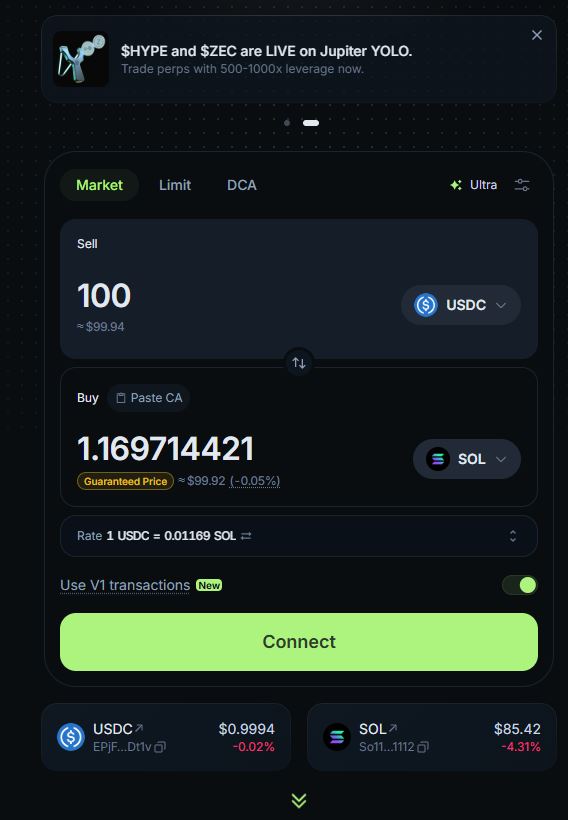
What started as a swap tool has since evolved into what the team calls a “DeFi superapp.” Today Jupiter offers spot swaps, limit orders, dollar-cost averaging, perpetual futures, lending, liquid staking, a native stablecoin called JupUSD, and even prediction markets through a Polymarket integration. It is no longer just an aggregator. It is the front door to Solana DeFi.
How Jupiter Works Under the Hood
Here is the part most reviews skip. Jupiter is not a DEX. It does not hold your funds or operate its own liquidity pools for spot trading. It is a routing layer that connects your wallet to the best available liquidity across the Solana ecosystem.
When you initiate a swap, three things happen in sequence:
- Quote generation: Jupiter queries every connected DEX and market maker for prices, refreshing quotes in parallel.
- Route construction: Metis builds a multi-hop path. If swapping SOL directly for a low-cap token gives you a bad rate, Jupiter might route through USDC or USDT to get you a better final output.
- Transaction landing: The trade is signed in your wallet and sent to Solana, often landing in under two seconds thanks to Solana’s proof-of-history architecture.
The platform also runs a second routing layer called JupiterZ, which lets market makers quote prices offchain. According to Jupiter’s own documentation, these market maker quotes can beat onchain routes by 5 to 20 basis points on major pairs, though that is a project claim rather than an independently verified result.
In October 2025, Jupiter launched Iris, a meta-aggregator that routes trades through competing aggregators like OKX and dflow when they offer better execution than Jupiter’s own engine. That move was a direct response to rising competition, and it tells you something important: Jupiter is no longer competing only on being the best router.
It is competing on being the default front-end, even if the actual execution happens elsewhere.
Key Products and Features
Jupiter’s product suite has expanded aggressively. Here is a quick breakdown of what you can actually do on the platform:
| Product | What It Does | Who It’s For |
|---|---|---|
| Ultra Swap | Automated swap mode with slippage, priority fees, and routing handled for you | Most retail traders |
| Manual Swap | Full control over routes, slippage, and MEV protection settings | Advanced traders |
| Limit Orders | Set a target price and let the order execute onchain | Traders who do not want to monitor charts |
| DCA | Automate recurring buys over time | Long-term accumulators |
| Jupiter Perps | Leveraged longs and shorts against the JLP pool, up to 100x | Experienced derivatives traders |
| Jupiter Lend | Earn yield on deposits or borrow against collateral | Yield seekers and borrowers |
| Jupiter Studio | A curated launchpad for new Solana projects | Early-stage token hunters |
| JupUSD | Native stablecoin | Users who want a Jupiter-native dollar |
| Prediction Markets | Integrated via Polymarket partnership | Event traders |
The JLP pool deserves special attention. Jupiter Perps does not rely on external market makers. Traders deposit collateral and trade against a pooled liquidity token called JLP. The pool takes the opposite side of every trade and earns fees in return. This model provides deep, always-available liquidity, but it also means JLP holders carry counterparty risk. In extreme volatility, the pool can take severe losses.
That is not a hypothetical concern. It is a structural feature of the design.
Jupiter Fees:
Jupiter’s fee structure is one of the most misunderstood parts of the platform. Here is the reality in plain terms.
Jupiter’s Ultra mode charges different rates depending on the pair:
- 0% on stablecoin-to-stablecoin swaps and liquid staking token pairs
- 0.02% on SOL-to-stablecoin swaps
- 0.05% on liquid staking token-to-stablecoin swaps
- 0.1% on most other swaps
- 0.5% on tokens less than 24 hours old
Manual mode carries no Jupiter commission, but you also lose MEV protection and automated routing optimization. Limit orders and DCA add a base fee of 0.03% to 0.1% on top of the Ultra routing fee. And separately, you always pay Solana network fees, which apply even when a transaction fails.
The key insight here is that Jupiter’s 0.1% fee is usually offset by the 0.3% to 0.5% better pricing you get through aggregation. On a $10,000 trade, that means paying roughly $10 in Jupiter fees to save $30 to $50 in slippage. The math works in your favor for most trades above a few hundred dollars. For micro-trades, the network fee dominates and the aggregation advantage shrinks.
Traction, Users, and Market Share
Jupiter’s growth numbers are genuinely impressive, but the story is more nuanced in 2026 than it was a year ago.
At its peak, Jupiter handled approximately 95% of all DEX aggregator volume on Solana and over 50% of total Solana DEX trading volume. It processed more than 1.4 billion swaps valued at roughly $80 billion in Q2 2025 alone. Cumulative swap volume has surpassed $2.2 trillion.
Total value locked across the platform has ranged between $1.6 billion and $3 billion depending on the snapshot date and market conditions.
Then came the competition.
By mid-2026, Jupiter’s daily routed aggregator volume share dropped below 50% for the first time, hitting 48.9%. OKX captured 31.3% of daily routed volume, dflow took 16%, and Titan grabbed roughly 4%. On a monthly basis, Jupiter still holds over 70% aggregator market share, but the daily trend is clear: the moat is narrowing.
Why is this happening? OKX has a built-in distribution advantage with millions of centralized exchange users who can be funneled directly into Solana DEX trading. Dflow offers an auction-based routing model focused on MEV protection. And Jupiter’s own Iris meta-aggregator, while clever, creates a philosophical problem: if Jupiter is routing through OKX anyway, why should traders not just use OKX directly?
The honest answer is that Jupiter’s brand, product depth, and user experience still matter. But the era of uncontested dominance is over.
Why Jupiter Still Matters for Solana
Despite the competitive pressure, Jupiter’s unique selling proposition remains strong. Here is why it still matters.
It solves the fragmentation problem better than anyone else on Solana. Solana has dozens of DEXs, each with its own liquidity pools, fee structures, and quirks. Jupiter abstracts all of that complexity into a single interface. For new users, that is the difference between trading and giving up.
It is the liquidity layer that other apps build on. Wallets, dApps, and trading terminals integrate Jupiter’s API to power their own in-app swaps. When you swap inside Phantom or Backpack, there is a good chance Jupiter is doing the routing behind the scenes. That makes Jupiter infrastructure, not just a destination.
It has diversified beyond swaps. Perpetuals, lending, DCA, limit orders, and a launchpad create multiple revenue streams and multiple reasons to stay on the platform. Most aggregators are one-trick ponies. Jupiter is building an ecosystem.
It has a clean security record. Jupiter’s core contracts have been audited by Ottersec and Offside Labs, and there has been no exploit of its core smart contracts since launch. The one notable incident was a February 2025 compromise of Jupiter’s X account used to promote scam tokens.
That was a social media breach, not a protocol hack, and user funds held in multisigs were unaffected. In a sector where bridge hacks and exploit headlines are routine, that track record matters.
Recommended Article: SOL To USDT Swap Guide
The JUP Token: Governance, Buybacks, and Unlock Pressure
No review of Jupiter is complete without addressing the JUP token, because the relationship between the platform’s success and the token’s price is complicated.
JUP is the governance token of the Jupiter DAO. Staking JUP gives you voting rights and eligibility for Active Staking Rewards, which are distributed quarterly. The token does not give holders a direct claim on protocol fees. According to Jupiter’s own documentation, JUP holders “do not receive a direct percentage of protocol fees”.
What they do get is indirect exposure through the Litterbox Trust. Fifty percent of Jupiter’s onchain revenue flows into this trust, which uses it to programmatically buy JUP on the open market. The trust has accumulated over 142 million JUP and burned approximately 134 million JUP, equal to about 4% of circulating supply. Jupiter also spent over $70 million on buybacks in 2025.
The supply story has improved. The team burned 3 billion JUP from its initial vesting schedule in January 2025, reducing max supply from 10 billion to 7 billion. Additional burns brought total supply down to roughly 6.865 billion. In February 2026, the DAO voted emissions to net zero, and the planned Jupuary 2026 airdrop was cut from 700 million to 200 million JUP following community concerns about dilution.
But the token’s price history is a cautionary tale. JUP debuted in January 2024 around $0.41 to $0.72, pushing its fully diluted market cap above $6 billion. It peaked above $2 shortly after launch, rallied to around $1.40 during the second Jupuary in 2025, and then ground down to $0.13 by October 2025. It has since recovered to roughly $0.19 at the time of writing.
The core tension is simple: Jupiter is a great product, but a great product and a token that captures that value are two different things. The Litterbox Trust and buyback program are real mechanisms, but they have not been enough to fully absorb unlock pressure. Around 3.5 billion JUP still sits in protocol custody with no unlock schedule, meaning the DAO will decide its fate later. That is the single biggest overhang on the token.
If you are buying JUP, you are not just betting on Jupiter’s trading volume. You are betting on the DAO’s ability to convert that volume into tokenholder value. That is a governance bet as much as a product bet.
Community Feedback
Online sentiment around Jupiter is mixed, and the criticisms are worth taking seriously.
On Reddit, experienced Solana users consistently praise Jupiter’s routing quality. One thread notes that Jupiter “routes your request to over 43 AMMs and gives you the best priced tokens out of every LP even for one swap”. Another user highlights that Jupiter rewrote its codebase to reduce compute and land more transactions per slot, which is the kind of low-level optimization that matters on Solana.
But the same forums contain legitimate complaints. A widely discussed issue emerged in January 2026 when Jupiter required Q4 ASR stakers to export their seed phrases into the Jupiter wallet to claim rewards. Community members argued that exposing seed phrases for relatively small payouts created serious security risks.
Jupiter defended the requirement as a way to prevent abuse and promised an alternative claiming mechanism, but the episode damaged trust among self-custody purists.
On the Jupiter DAO forum, debates about reward distribution have been heated. One long-time user with “hundreds of thousands of organic volume” threatened to “FUD it to death on social media” if the reward structure shifted too far toward linear staking. Another thread discussed whether implementing KYC on a DEX would help detect sybil wallets or undermine the core privacy advantages of decentralized trading.
The pattern is consistent: users love the product, but they are skeptical of the tokenomics and some of the team’s operational decisions. That is a fair critique. Jupiter has earned its dominant position through execution, but it has also made missteps that a more mature protocol would have avoided.
Risks and Limitations:
No review is honest without a clear-eyed look at the downsides. Here is what you should weigh before committing capital to Jupiter.
Single-chain exposure. Jupiter runs exclusively on Solana. If Solana experiences a prolonged outage or consensus failure, all Jupiter products freeze. Solana has a history of periodic downtime, and that risk is baked into the platform’s architecture.
Limited audit coverage. Two audits from Ottersec and Offside Labs is decent, but peers like Aave and EigenLayer have three or more top-tier audit firms on record. Complex modules like JLP perps may harbor undetected risks.
Counterparty risk in JLP. If you provide liquidity to the JLP pool, you are the counterparty to traders. In extreme volatility, the pool can incur severe losses. This is not a bug. It is the design.
Governance concentration. The Jupiter DAO controls upgrade authority, but the exact multisig thresholds are not publicly documented. Governance is decentralized in name, but the practical concentration of voting power is harder to verify.
Token unlock overhang. As discussed, billions of JUP remain in protocol custody with no schedule. Future DAO decisions could introduce new sell pressure.
Should You Use Jupiter in 2026?
Jupiter remains the best place to swap tokens on Solana. Full stop. The routing engine is battle-tested, the product suite is deeper than any competitor’s, and the security record is clean by DeFi standards. If you are trading on Solana and you are not using Jupiter for at least some of your swaps, you are probably leaving money on the table.
But the platform is no longer invincible. OKX and dflow are eating into its daily market share, and the JUP token has not consistently reflected the platform’s operational success. If you are here purely for the product, Jupiter delivers.
If you are here for the token, you need to understand the governance and unlock dynamics before you size a position.
NOTE: use Jupiter for execution, watch the DAO closely, and do not assume that dominant market share automatically translates into token upside. In crypto, the gap between a great product and a great token is where most investors get hurt.
Frequently Asked Questions
1. Is Jupiter DEX safe to use?
Jupiter has a clean protocol-level security record. Its core contracts have been audited by Ottersec and Offside Labs, and there has been no exploit of its core contracts since launching in 2021. The February 2025 X account hack was a social media breach, not a smart contract vulnerability, and user funds were not affected. That said, no DeFi platform is risk-free, and you should always verify transaction details before signing.
2. What is the difference between Jupiter and a regular DEX like Raydium?
Raydium is a single DEX with its own liquidity pools. Jupiter is an aggregator that routes your trade across Raydium and dozens of other Solana DEXs to find the best price. You are not choosing between Jupiter and Raydium. You are using Jupiter to access Raydium’s liquidity alongside everyone else’s.
3. How much does Jupiter charge per swap?
Jupiter’s Ultra mode charges 0% on stablecoin pairs, 0.02% on SOL-to-stablecoin swaps, 0.1% on most other swaps, and 0.5% on tokens less than 24 hours old. Manual mode carries no Jupiter commission. You also pay Solana network fees separately, even if a transaction fails.
4. Does holding JUP give me a share of Jupiter’s revenue?
No. JUP holders do not receive a direct percentage of protocol fees. Instead, 50% of Jupiter’s onchain revenue flows into the Litterbox Trust, which buys and burns JUP on the open market. Stakers also earn Active Staking Rewards quarterly, but these are not a direct revenue share.
5. Why did JUP’s price fall so much after its launch?
JUP launched in January 2024 with a heavily anticipated airdrop that pushed the price above $2. Since then, roughly 2 billion tokens have entered circulation through airdrops and unlocks, creating persistent sell pressure. Buybacks and burns have helped, but they have not been enough to fully offset the increase in circulating supply.
6. Is Jupiter available on chains other than Solana?
No. Jupiter is Solana-native and does not operate on Ethereum, Base, or any other chain. It has a bridge product in beta that compares routes across 50+ chains, but the core aggregator and all trading products run exclusively on Solana.
7. What is JLP and should I provide liquidity to it?
JLP is the liquidity pool that backs Jupiter Perps. Traders trade against the pool, and JLP holders earn fees in return. It offers attractive yields, but you are taking on counterparty risk. In extreme market conditions, the pool can suffer severe losses. Only provide liquidity if you understand that risk and can tolerate volatility in the JLP token price.
8. Is Jupiter still the biggest DEX aggregator on Solana?
Yes, but its lead has narrowed. Jupiter still holds over 70% of monthly aggregator market share, but its daily routed volume share dropped below 50% in mid-2026 as OKX and dflow gained ground. It remains the dominant front-end for Solana traders, but the competitive landscape is no longer a one-horse race.








1 Comment