If you have been active in DeFi for more than a week, you know that liquidity is the oxygen of any decentralized exchange. Without it, swaps fail, slippage eats profits, and protocols suffocate. Velodrome Finance emerged in 2022 to solve this exact problem on Optimism.
But in 2026, with the rise of competing L2s and shifting tokenomics, does it still deserve a place in your portfolio?
I have tested Velodrome extensively across multiple market cycles. In this review, I will break down exactly how it works, what it costs, and whether the VELO token still has a pulse.
What Is Velodrome Finance?
Velodrome Finance is a next-generation Automated Market Maker (AMM) built natively on the Optimism Layer 2 network. It was designed as a public good, launching in June 2022 without venture capital funding or a token sale. The protocol combines the best features of Curve (vote-escrow governance), Convex (bribe markets), and Uniswap (efficient swaps) into a single liquidity hub.
The core mission is simple: provide the deepest liquidity on Optimism at the lowest possible cost while empowering token lockers to direct emissions to the pools that need them most.
How Velodrome Works: The ve(3,3) Engine
Velodrome’s mechanics are not just a copy-paste of Uniswap. It operates on a vote-escrow model that aligns incentives between traders, liquidity providers, and long-term token holders.
Stable and Volatile Pools
Velodrome uses a dual-AMM architecture:
- Stable Pools: Optimized for assets that should trade near parity (e.g., USDC/DAI). These pools use a low-slippage curve similar to Curve.
- Volatile Pools: Designed for uncorrelated assets (e.g., ETH/OP). These use a constant-product formula with higher fee capture to compensate for impermanent loss risk.
The Voting Flywheel (veVELO)
The heart of the protocol is veVELO. Here is how the cycle works:
- Lock: Users lock their VELO tokens for a period of up to 4 years to receive veVELO (represented as an NFT).
- Vote: Every week (epoch), veVELO holders vote on which liquidity pools should receive VELO emissions.
- Earn: Voters receive 100% of the trading fees and external incentives (bribes) generated by the pools they voted for.
- Bribe: Protocols or projects that want liquidity can offer “bribes” (incentive payments) to veVELO voters to secure emission votes.
This creates a marketplace where liquidity is bought and sold, but the profits flow back to the token lockers rather than just the LPs.
Key Assets Supported and Fees
Velodrome supports the vast majority of assets within the Optimism ecosystem. Whether you are trading OP, ETH, USDC, or the latest memecoin, there is likely a pool for it.
Supported Assets:
- Layer 2 Native Tokens: OP, ETH (bridged), WBTC.
- Stablecoins: USDC, USDT, DAI, sUSD.
- Governance Tokens: VELO, and other ecosystem project tokens.
- Concentrated Liquidity Pairs: Through the Slipstream upgrade, Velodrome now supports concentrated liquidity positions for higher capital efficiency.
Fee Structure
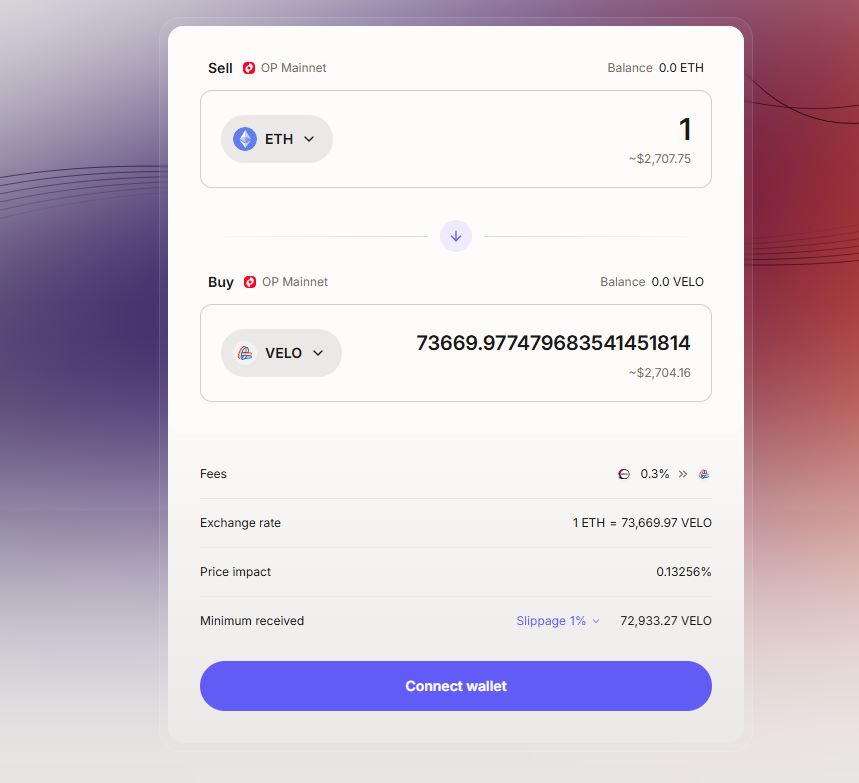
Velodrome is known for being aggressive on fees to attract volume. Here is the breakdown:
| Pool Type | Trading Fee | Impact on User |
|---|---|---|
| Stable Pools | 0.02% – 0.05% | Extremely low; ideal for stable swaps. |
| Volatile Pools | 0.02% – 0.05% | Significantly lower than Uniswap V2 (0.30%). |
| Slipstream (CL) | Variable | Dynamic fees based on volatility. |
| Transaction Cost | Network Gas | Usually < $0.10 per swap on Optimism. |
Note: Fees are paid in the tokens you are swapping. There is no separate protocol token fee for basic swaps.
Why VELO Token Is Important?
You cannot discuss Velodrome without addressing the VELO token. It is not just a governance ticker; it is the economic battery that powers the entire exchange.
- Emission Control: VELO emissions are the primary incentive for liquidity providers. Without VELO, LPs would likely withdraw capital, causing slippage to skyrocket.
- Value Accrual: As a veVELO holder, your voting power is proportional to the fees and bribes your pool generates. If you vote for high-volume pools, you earn a share of the revenue.
- Anti-Dilution: The protocol implements rebases for voters. If you lock your tokens, you receive rebases (new VELO emissions) to help offset the dilution from the continuous emission schedule.
Token Stats (as of mid-2026):
- Circulating Supply: ~17.56 Billion VELO.
- Max Supply: 24 Billion VELO.
- Market Cap: Approximately $56 Million (subject to market volatility).
What Crypto Users Are Saying Online About This DEX:
Velodrome has a mixed reputation depending on where you look. It is praised for mechanics but criticized for token performance and centralization.
Positive Feedback
- User Experience: On Farcaster, a reviewer noted, “Pretty straightforward dApp… Nice speed, I was able to convert my token with no delay.” They rated the interface 5/5.
- Utility: Educational platforms like OKX highlight that Velodrome offers some of the lowest swap fees on Optimism, often under 0.05%.
- Community Focus: It is frequently mentioned that Velodrome had no VC funding, which appeals to decentralization maximalists.
Critical Feedback (The Risks)
- Governance Centralization: According to Hindenrank’s risk analysis, just 100 wallets control 63% of veVELO voting power. This means a small group of whales effectively decides where emissions go.
- Revenue Cliff: Analysts at Delphi Digital have warned of an “Emission Cliff.” As VELO emissions decrease over time (post-2026), fee revenue could drop by up to 65% if organic trading volume doesn’t replace the incentive-driven volume.
- Token Sentiment: On Binance Square, a trader noted, “$VELODROME is not recommended for long-term holding; it can be traded for short-term gains.” They expressed frustration with the price performance compared to the Aerodrome fork on Base.
Is Velodrome Safe?
From a technical standpoint, Velodrome has a relatively clean track record. It has passed multiple audits (including CertiK) and has not suffered a major catastrophic exploit of its core contracts.
However, Hindenrank gives Velodrome a B risk grade (26/100). This is not because the code is broken, but because of economic and governance risks.
Top 3 Risks to Watch:
- Merger with Aerodrome: There are ongoing plans to merge Velodrome (Optimism) with Aerodrome (Base). This could dilute current VELO holders or shift the economic center of gravity away from Optimism.
- Governance Oligarchy: The concentration of voting power means smaller holders have little say in the direction of the protocol.
- Reduced TVL: Total Value Locked has fluctuated significantly, dropping from highs as liquidity migrated to other chains like Base.
Velodrome vs Competitors
| Feature | Velodrome (Optimism) | Uniswap (Optimism) | Curve (Ethereum) |
|---|---|---|---|
| Primary Strength | Incentive/Bribe Model | Brand & Routing | Stablecoin Swaps |
| Swap Fees | 0.02% – 0.05% | 0.01% – 0.30% | 0.04% – 0.4% |
| Governance | ve(3,3) / Bribes | Token Voting | veCRV / Bribes |
| VC Funded? | No | Yes | Yes |
| Key Drawback | Whale Centralization | High gas on Mainnet | Complexity |
Conclusion
Velodrome Finance is not a “set it and forget it” investment. It is an active participant’s protocol.
If you are a trader, Velodrome is arguably one of the best places to swap on Optimism due to its rock-bottom fees and deep stable liquidity.
If you are a yield farmer, the veVELO voting mechanism offers some of the most sophisticated yield strategies in DeFi. However, you must be willing to lock tokens for the long haul and actively participate in weekly votes to capture bribes.
If you are a passive investor, be wary. The emission cliff, whale governance, and the looming Aerodrome merger introduce significant uncertainty.
My advice: Use Velodrome as an infrastructure tool to swap cheaply, but treat the VELO token with high caution. Diversify your liquidity across multiple protocols to mitigate the governance and emission risks associated with any single DEX.
Frequently Asked Questions (FAQs)
Find answers to common questions about Velodrome, VELO, veVELO, trading fees, liquidity, bribes, and Slipstream.
What is the difference between VELO and veVELO?
VELO is the liquid, transferable token you can buy on exchanges. veVELO (vote-escrow VELO) is a non-transferable NFT you receive when you lock VELO for a period. veVELO grants voting power and the right to claim bribes, but it cannot be sold or transferred independently of the NFT.
What are the trading fees on Velodrome?
Velodrome charges between 0.02% and 0.05% per swap for both stable and volatile pools. This is significantly lower than the standard 0.30% fee found on Uniswap V2 style pools.
How do I earn money with Velodrome?
There are three main ways:
- Provide Liquidity: Earn trading fees and VELO emissions.
- Lock & Vote (veVELO): Vote for specific pools to earn their trading fees and bribes.
- Bribe Hunting: Vote for pools with the highest bribe payouts to maximize ROI.
Is Velodrome safe from hacks?
As of 2026, Velodrome has not suffered a major smart contract hack of its core AMM. It has been audited by firms like CertiK. However, “safe” does not mean risk-free. The primary risks are economic, including governance centralization, and market-based, including impermanent loss.
What is the “Bribe” mechanism?
Bribes are essentially incentives paid by external protocols to veVELO voters. If a project wants their token pair to have deep liquidity, they “bribe” voters to direct VELO emissions to their pool. Voters keep these bribes as profit.
Will Velodrome merge with Aerodrome?
There are active discussions and plans for a cross-chain merger between Velodrome (Optimism) and Aerodrome (Base) to form a unified “Aero” DEX. This is a key risk factor as it may dilute current VELO holders or shift value to the Base ecosystem.
What is the current price of VELO?
The price of VELO is highly volatile. As of mid-2026, it has been trading in the $0.003 to $0.006 range, with a market cap hovering around $56M-$100M depending on daily fluctuations.
Do I need OP tokens to use Velodrome?
You need ETH on the Optimism network to pay for gas fees. The gas fees are extremely low (often a few cents), but you must bridge ETH to Optimism before interacting with the DEX.
What is “Slipstream”?
Slipstream is Velodrome’s concentrated liquidity upgrade. It allows LPs to provide liquidity within specific price ranges, mimicking Uniswap V3. This offers much higher capital efficiency and potentially higher fees for active managers.