Wallet of Satoshi is the most downloaded Lightning wallet on the planet, and for good reason. It gets a non-technical user from download to first Bitcoin payment in under a minute. That convenience built a user base of more than one million downloads and billions of dollars in monthly transaction volume.
It also built a reputation that is now being rebuilt, as the wallet transitions away from the custodial model that made it famous.
This review breaks down what Wallet of Satoshi actually is in 2026, how its fees work, where the custody risk sits, and how it compares with seven other Lightning wallets that compete for the same everyday-spending use case. It also answers a question that comes up constantly: how much staking APY does Wallet of Satoshi pay? The short answer is zero, and that is not a flaw. It is a feature of Bitcoin’s proof-of-work design.
What Is Wallet of Satoshi?
Wallet of Satoshi launched in beta around January 2019 and reached public app stores in May 2019. It was built by Daniel Alexiuc in Brisbane, Australia, under Living Room of Satoshi, a bill-payment company that became the first Bitcoin-related entity in Australia to obtain an Australian Financial Services Licence in 2019.
The original thesis was simple: remove every technical barrier between a person and a Lightning payment. No channels, no node management, no seed phrase ceremony. Just download, receive, and spend.
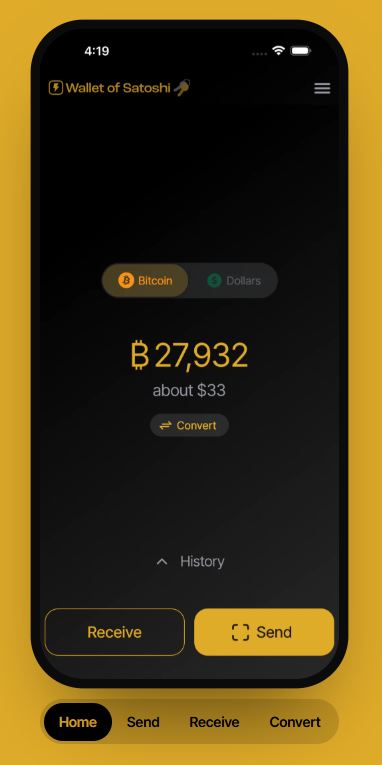
That thesis worked. Wallet of Satoshi has processed more than 19 million transfers since launch, surpassed one million downloads, and handled an estimated $1.1 billion in monthly transaction volume from 5.22 million transactions in November 2025. It operates in more than 170 countries and has become the default onboarding layer for Lightning payments in emerging markets, merchant pilots, and community Bitcoin projects.
Its importance to the Lightning ecosystem is difficult to overstate. For years, Wallet of Satoshi was the answer to the question “how do I pay with Bitcoin without running a node?” It proved that Lightning could feel like Venmo, not like a science experiment. That proof pushed other wallets to simplify onboarding and gave merchants a reason to accept Lightning in the first place.
The regulatory picture is more complicated. Wallet of Satoshi ceased operations in the United States in November 2023 amid regulatory scrutiny, and in late 2024 it began winding down custodial services in the European Union to comply with MiCA rules.
Users outside those regions still have access, but the wallet is no longer a global custodial product in the way it once was.
Core Features and the Custody Shift
Wallet of Satoshi supports on-chain Bitcoin, Lightning payments, Lightning addresses, NFC tap-to-pay, and a built-in point-of-sale mode for merchants. Users can buy Bitcoin inside the app through a third-party provider, hold a USD balance in some regions, and display balances in more than 170 fiat denominations.
The bigger story is custody. Wallet of Satoshi built its reputation as a custodial wallet, meaning the company held the keys and users relied on an email login for backup. That model is now being replaced. The official app describes a self-custody design with a 12-word recovery phrase, and the legacy custodial service is being phased out in favor of a self-custody model built on Spark. The transition has not been smooth.
Users on Stacker News and Reddit have questioned whether the new “self-custodial” mode is truly self-custodial, pointing out that recovery depends on a recovery bundle and that federated operators can still influence exits.
The practical takeaway is this: Wallet of Satoshi is no longer purely custodial, but it is also not a pure self-custody wallet in the same way Phoenix or Zeus is. It sits in a hybrid middle ground that is still evolving.
Fees:
Wallet of Satoshi does not charge a subscription fee. Its fee structure is simple on the surface, but the on-chain rail is where costs appear.
| Action | Wallet of Satoshi fee |
|---|---|
| Lightning send | No WoS fee; routing fees of a few sats may apply |
| Lightning receive | No WoS fee |
| On-chain Bitcoin top-up | 1.95% conversion fee |
| On-chain send | 1.95% plus the current miner fee |
| In-app Bitcoin purchase | Third-party provider fees apply |
The Lightning rail is effectively free for most users because Wallet of Satoshi runs well-connected nodes and absorbs most routing costs. The on-chain rail is expensive by design: a 1.95% conversion fee plus miner fees makes small on-chain transfers impractical.
For users who stay on Lightning, the cost profile is competitive with any custodial wallet. For users who move between on-chain and Lightning frequently, the costs add up quickly.
Security and the Real Trade-Off
The security question depends entirely on which mode a user is in. In the legacy custodial mode, Wallet of Satoshi held the keys, capped balances at 5 BTC, and relied on email access for recovery.
That model is convenient but exposes users to platform risk: a provider compromise, regulatory freeze, or operational failure could block access to funds. App Store reviewers have praised the simplicity while warning users not to store large amounts, and some have complained about transaction failures and slow support.
The self-custody mode reduces counterparty risk, but it introduces recovery responsibility. If a user loses the 12-word phrase, the funds are gone. That is the standard self-custody trade-off, and it is why Wallet of Satoshi still works best as a spending wallet rather than a savings wallet. For larger holdings, pairing it with a hardware wallet is the sensible approach.
Wallet of Satoshi vs Seven Other Lightning Wallets
The Lightning wallet market is crowded, and each wallet makes a different trade-off between custody, fees, and technical complexity. The table below compares Wallet of Satoshi with seven alternatives on the metrics that matter for everyday spending.
None of these wallets offer staking APY, because Bitcoin does not have native staking. Any “staking” yield in crypto usually comes from proof-of-stake assets or lending products, not from a Bitcoin Lightning wallet.
| Wallet | Custody | Lightning send fee | On-chain or receive cost | Staking APY | Best for |
|---|---|---|---|---|---|
| Wallet of Satoshi | Hybrid, custodial legacy plus self-custody transition | No WoS fee, routing only | 1.95% on on-chain top-ups and sends | 0% | Beginners, merchants, small payments |
| Phoenix | Self-custodial | 0.4% + 4 sats | Free with liquidity; 1% + mining when channel op needed | 0% | Users who want true self-custody with simple UX |
| Breez | Self-custodial | Routing only after channel open | ~0.75% channel-open fee | 0% | Cost-conscious self-custody users |
| Muun | Self-custodial | Swap-based, variable | No wallet fee, but swap and network costs can spike | 0% | Simple Bitcoin storage with occasional Lightning |
| BlueWallet | Self-custodial on-chain, custodial Lightning option | Routing only | No platform fee, pay Bitcoin network fees | 0% | Bitcoin power users who want flexibility |
| Blink | Custodial by default, self-custody option | 0% service fee, ~0.02% routing | 2,500 sats fixed or 0.2% spread on on-chain | 0% | El Salvador and community Bitcoin payments |
| Strike | Custodial | Free | ~1 sat on-chain withdrawal; 0.89% to 1.5% trading | 0% | Low-fee Bitcoin buying and Lightning payments |
| Zeus | Self-custodial node | Routing only | 10,000 sats channel fee up to 1M sats; 1% above | 0% | Technical users who want a node on their phone |
Phoenix is the closest thing to a true self-custodial Wallet of Satoshi. It opens channels automatically, but users pay for that liquidity. Reddit and Stacker News reviews consistently praise its custody model while warning that fees can feel high for small payments.
One App Store reviewer described fees of roughly 0.5% plus 3,000 sats per Lightning payment. Another Stacker News commenter called Phoenix “the better option today for true Lightning self-custody”.
Breez is cheaper at the point of use once a channel is open, with routing fees of a few sats per payment. The catch is the upfront channel-open fee of around 0.75%. Stacker News users describe it as significantly cheaper than Phoenix for regular spending, but some report routing failures when the wallet is not used frequently.
Muun has no wallet fee, but it routes Lightning payments through submarine swaps that touch the on-chain layer. That design makes fees unpredictable during congestion. Reviewers estimate Muun’s effective Lightning fees can run 10 to 50 times higher than Phoenix or Breez, and small payments are a poor fit.
BlueWallet is a reputable open-source Bitcoin wallet with no platform fees. It supports both on-chain self-custody and a custodial Lightning option. Reddit and Bitcointalk users recommend it for Bitcoin holdings, but note that its interface is less intuitive than newer wallets and that some features are hard to discover.
Blink grew out of Bitcoin Beach in El Salvador and offers 0% service fees on Lightning with minimal routing costs. The trade-off is a custodial default and a $1 monthly inactivity fee on dormant accounts, which triggered backlash after it affected roughly 100,000 accounts. It remains a strong choice for community payments in regions where Blink has merchant traction.
Strike offers free Lightning transactions and near-free on-chain withdrawals, but it is a custodial platform with a trading spread. Reddit users praise the low fees for dollar-cost averaging and Lightning transfers, while some report account closures and funds held for extended periods.
Zeus is the most technical wallet on this list. It runs a Lightning node on the user’s phone and charges only routing fees, plus channel-open costs of 10,000 sats for channels up to one million sats, or 1% for larger channels. It is cheap and sovereign, but the minimum channel size and node management make it unsuitable for casual users.
Online Reviews:
The review sentiment across Reddit, Stacker News, App Store listings, and crypto forums is remarkably consistent. Wallet of Satoshi wins on onboarding speed and loses on custody.
App Store reviewers call it “seriously easy to use” and note that “fees are negligible” on Lightning, but others complain about charges on deposits and withdrawals and about transactions failing or queuing. On Stacker News, the harshest critics argue that the new self-custody branding overstates how much control users actually have.
Phoenix reviews follow a similar pattern: users love the self-custody model and dislike the liquidity costs. Breez reviews praise the low ongoing fees but mention occasional routing problems.
Muun reviews consistently flag fee spikes. BlueWallet reviews emphasize reliability and open-source credibility, with UI complaints as the main drawback. Blink reviews are split between appreciation for its community roots and anger over the dormancy fee. Strike reviews highlight low fees but raise account-freeze concerns. Zeus reviews are positive among technical users and cautionary for everyone else.
Who Should Use Wallet of Satoshi?
Wallet of Satoshi is still the fastest way to get someone onto Lightning. For beginners, merchants accepting small payments, and users in regions where it remains available, it is a strong spending wallet. It is not a savings wallet, it is not a staking product, and it is not a replacement for self-custody.
Users in the United States and the European Union should check availability before relying on it, and anyone holding more than spending money should pair it with a hardware wallet or a self-custodial Lightning wallet like Phoenix.
The wallet’s importance to the Lightning ecosystem is secure. It proved that Bitcoin payments could be simple. The next chapter is whether it can prove that simplicity and self-custody can coexist.
Frequently Asked Questions
1. Is Wallet of Satoshi self-custodial?
It is transitioning to self-custody. The legacy service was custodial, and the new app uses a 12-word recovery phrase with a Spark-based model. Some reviewers argue it is not fully self-custodial because recovery depends on a recovery bundle and federated operators.
2. Does Wallet of Satoshi offer staking APY?
No. Wallet of Satoshi pays 0% staking APY. Bitcoin uses proof-of-work, not proof-of-stake, and Lightning wallets are payment tools, not staking platforms.
3. What are Wallet of Satoshi’s fees?
Lightning sends and receives carry no Wallet of Satoshi fee, though routing fees of a few sats may apply. On-chain top-ups cost 1.95%, and on-chain sends cost 1.95% plus the miner fee.
4. Is Wallet of Satoshi available in the US and EU?
No. It ceased US operations in November 2023 and began winding down custodial services in the EU in late 2024.
5. How many users does Wallet of Satoshi have?
It has surpassed one million downloads and processed more than 19 million transfers since 2019.
6. Is Wallet of Satoshi safe for large amounts?
It is best treated as a spending wallet. The custodial legacy model capped balances at 5 BTC, and the self-custody model puts recovery responsibility on the user. Large holdings belong in cold storage.
7. What is the best alternative to Wallet of Satoshi?
For true self-custody with simple UX, Phoenix is the most direct alternative. For lower ongoing fees after setup, Breez is competitive. For a free open-source Bitcoin wallet, BlueWallet is a strong choice.
8. Does Wallet of Satoshi support Lightning addresses?
Yes. Users can register a Lightning address, share it like an email handle, and receive repeat payments without generating a new invoice each time.