
The Lightning Network has matured from a technical curiosity into Bitcoin’s de facto payment rail. In 2026, it is no longer a question of whether you should use Lightning for everyday spending, but which wallet gives you the right balance of self-custody, liquidity, and cost.
I have spent over a decade watching crypto infrastructure evolve, and the Lightning wallet landscape today is finally usable for normal people, not just node operators. But the trade-offs are sharper than ever: a custodial wallet that feels like a neo-bank can freeze your funds, while a fully self-custodial setup can surprise you with channel fees that dwarf the payment itself.
This guide cuts through the marketing. It covers eight wallets that matter in 2026, with hard data on launch dates, user traction, fee structures, and what real users on Reddit and Bitcoin forums are actually saying. Treat these wallets as spending tools, not vaults. For long-term storage, a hardware wallet remains non-negotiable.
Quick Comparison: Best Lightning Wallets in 2026
| Wallet | Custody | Launch | Best For | Core Fee Structure | Traction Signal |
|---|---|---|---|---|---|
| Phoenix | Self-custodial | Dec 2019 | Mainstream self-custody without node management | 0.4% + 4 sats send; 1% + mining fee on inbound liquidity | Benchmark self-custodial wallet; 880 GitHub stars, active since 2019 |
| Wallet of Satoshi | Custodial / self-custody (regional) | 2018 | Absolute beginners and tiny balances | 1.95% on top-ups; 1.95% + network fee on on-chain sends | Over 1 million downloads; most-downloaded Lightning wallet globally |
| Strike | Custodial | 2020 | Fiat-to-Bitcoin and Lightning payments | 0.01–0.15% routing; tiered trading fees | 1.2 million downloads; ~2 million Lightning transactions per month |
| Breez | Self-custodial | 2020 | Merchants and point-of-sale | 0.75% channel-open; ~0.5% swap fees | Breez SDK reaches nearly 2 million users through partners like Cake Wallet |
| Muun | Self-custodial (2-of-2 multisig) | 2019 | Simple on-chain and Lightning in one balance | No published schedule; swap-based, often 10–50x higher than native Lightning | 500,000+ Android downloads; 4.1–4.8 star ratings |
| Alby | Self-custodial (Alby Hub) | 2021 | Browser payments, Nostr, and web logins | Free self-hosted Hub; Alby Cloud from $9.90/month | ~40,000 extension users; 44k+ Twitter followers |
| Zeus | Self-custodial | 2020 | Node runners and power users | No processing fee; LSP channel ~6,000–10,000 sats | 34,000 Android installs; 4.3–4.6 star ratings |
| Blink | Custodial / self-custody transition | 2020 | Bitcoin Beach heritage and merchant tools | Zero Blink-to-Blink; $1 monthly dormancy fee on inactive custodial accounts | ~100,000 custodial accounts affected by dormancy fee |
Phoenix:
The Benchmark for Self-Custodial Simplicity
Phoenix, built by French Lightning infrastructure firm ACINQ, launched in December 2019 and remains the cleanest answer to a difficult question: how do you give someone self-custody without asking them to understand inbound liquidity?
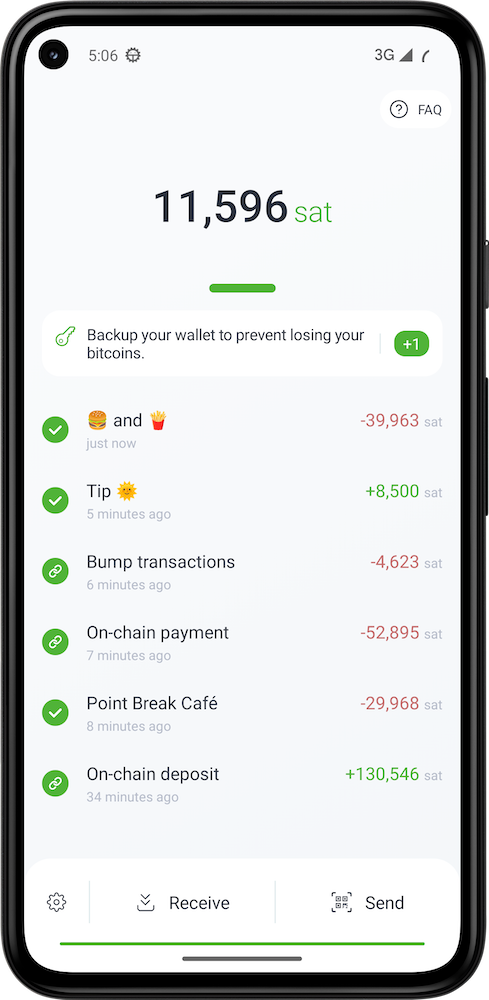
The wallet runs a real Lightning node on your phone behind a 12-word seed, and ACINQ’s LSP automatically opens and splices a single channel on demand. There is no manual channel management. That convenience has a price. Sending over Lightning costs 0.4% + 4 sats, while receiving is free only when liquidity already exists; if a channel operation is needed, you pay 1% plus mining fees, and channel creation adds roughly 1,000 sats.
A widely shared Reddit thread in r/lightningnetwork captured the friction perfectly: a user was stunned by a first-receive fee of “1%, plus mining fees, plus a one-time 1,000 Sat channel creation fee,” before commenters explained that Phoenix remains “the most convenient” self-custodial option they had tried.
Phoenix pulled out of the US in May 2024 and returned in April 2025, a regulatory detour that says more about US policy than about the product’s quality.
For users who want genuine keys without running a node, Phoenix is still the gold standard.
Wallet of Satoshi:
The Onboarding King With a Custody Trade-off
No Lightning wallet has introduced more people to Bitcoin payments than Wallet of Satoshi. Launched in 2018 and now exceeding 1 million downloads, it is the most-downloaded Lightning wallet globally. The appeal is obvious: a Lightning address, instant invoices, and a UX that feels like a messaging app.
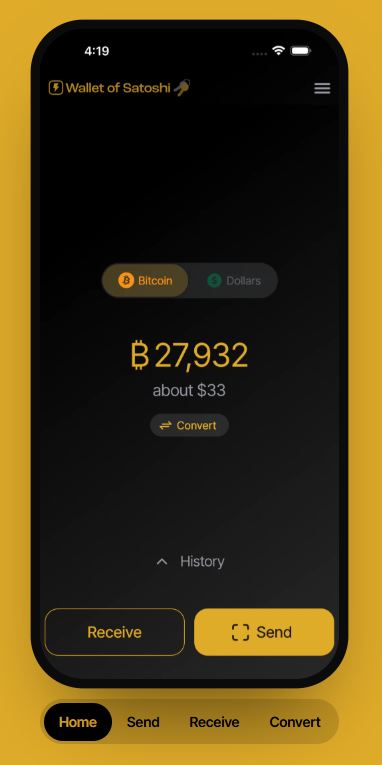
But Wallet of Satoshi is primarily custodial in most regions, meaning the company holds your keys and your balance is capped at 5 BTC. Fees are also a recurring complaint. The app charges 1.95% on Bitcoin top-ups, and on-chain sends carry the same 1.95% plus a network fee.
Google Play reviews swing between praise for simplicity and anger over hidden costs: one user noted being asked for “8k sats plus a percentage on top to send 5k,” while another praised how “instant the transaction was”. Wallet of Satoshi is a superb demo wallet and a terrible place to store meaningful value. Use it to onboard a friend, then move them to Phoenix or Zeus.
Strike:
The Fiat-to-Lightning Bridge for the Masses
Strike, founded by Jack Mallers in 2020, is less a wallet and more a Lightning-native financial app. It lets users buy Bitcoin, send payments over Lightning, and even spend from a cash balance while the recipient receives BTC. The traction is real: 1.2 million downloads, availability in 95+ countries, and roughly 2 million Lightning transactions per month as of April 2026.
Fees are among the lowest in the category for pure Lightning routing, often in the 0.01–0.15% range, though Strike’s fiat on-ramp and trading fees are tiered and less transparent than they first appear. Reddit sentiment is split. Users praise the clean interface and global reach, but multiple reports describe accounts frozen for 60 days or more under “high scam risk” flags, and some complain about seven-day deposit holds.
Strike is the best option for someone who wants to convert fiat to Lightning in seconds, but it is a custodial, regulated platform. Do not treat it as a sovereign wallet.
Breez:
The Merchant’s Self-Custodial Point of Sale
Breez occupies a niche no other self-custodial wallet has filled: it turns a phone into a Lightning cash register. The app includes a built-in point-of-sale mode with an item catalog, fiat pricing, and transaction exports, all while keeping keys on the user’s device.
The fee model is built around channel setup: Breez charges a 0.75% channel-open fee on the capacity being opened, and submarine swaps for on-chain movement are handled through partners like Boltz at roughly 0.5% plus mining fees.
Breez’s broader impact comes through its SDK, which powers Lightning in partners such as Cake Wallet and the European neobank Deblock, reaching nearly 2 million users in aggregate. Community feedback is mixed on reliability. Long-time users on Stacker News call it “significantly cheaper than Phoenix at the point of use,” but others report that if the wallet is not used regularly, transactions “just don’t go through” because of routing failures.
For merchants who want self-custody and a ready-made POS, Breez is the most complete package available.
Muun:
The Simplest UX With the Most Expensive Lightning
Muun launched in 2019 with a clever design: a single balance that pays both on-chain Bitcoin addresses and Lightning invoices through submarine swaps, so users never see a channel.
It is a 2-of-2 multisig wallet where one key sits on your phone and one on Muun’s servers, and recovery requires an Emergency Kit PDF and a paper Recovery Code rather than a standard seed phrase. That onboarding is arguably the smoothest of any self-custodial wallet.
The problem is cost, because Muun is not a native Lightning wallet, its swap-based architecture makes Lightning fees 10 to 50 times higher than what you would pay on Phoenix or Breez, according to comparative reviews. Reddit users have documented high fees when moving from Muun to cold storage, and Stacker News commenters describe it as using “slow, unreliable, and expensive centralized swaps”.
Muun still has a place: it is excellent for pulling Bitcoin off an exchange via Lightning and then settling on-chain without managing channels. It is not the wallet to use for everyday coffee purchases.
Alby:
The Browser-Native Wallet for the Nostr Economy
Alby started in 2021 as a browser extension for one-click Lightning payments, and it has evolved into Alby Hub, a self-custodial Lightning node that connects to web apps via Nostr Wallet Connect (NWC). This is the wallet for people who tip creators on Nostr, pay for web services with sats, or want a persistent Lightning node without running dedicated hardware.
The Hub is free to self-host, while Alby Cloud costs from $9.90 per month for managed hosting with keys still on your device. Traction is smaller than the mobile-first wallets: roughly 40,000 extension users and about 1,840 daily active users on the browser extension. Reviews are polarized.
Many users praise the seamless NWC integration and “easiest to use” setup, but a 2025 controversy saw users report balances deducted under an inactivity-fee policy for legacy shared wallets created before 2023. Alby is powerful infrastructure for the Web3-curious Bitcoiner, but read the terms carefully before leaving a balance idle.
Zeus:
The Power User’s Node in a Pocket
Zeus is not for everyone, and that is precisely its value. Launched in 2020 by Evan Kaloudis, Zeus is an open-source, self-custodial wallet that can run a Lightning node on your phone or remotely control an LND or Core Lightning node you already operate.
There is no processing fee from Zeus itself; the cost comes from liquidity. A new LSP channel costs roughly 6,000–10,000 sats for a channel up to 1 million sats, and 1% for larger channels. The trade-off is complexity. Users on Stacker News and Reddit praise it as the best mobile interface for node runners, but warn that it is “NOT for beginners” and that payment success depends on how well you manage channels.
A security incident in August 2026 saw an attacker breach Zeus’s own infrastructure and close many LSP channels; the company says no customer funds were lost, but the event is a reminder that even self-custodial tools depend on centralized services for liquidity.
If you already run a node, Zeus is the missing remote control. If you do not, start with Phoenix.
Blink:
From Bitcoin Beach to a Custody Transition
Blink, formerly Bitcoin Beach Wallet, began in 2020 in El Zonte, El Salvador, as the wallet for the circular Bitcoin economy that later inspired the country’s legal tender law. It remains a strong custodial option for merchants and everyday users in emerging markets, with zero fees for Blink-to-Blink transfers and a Lightning address system that works over invoice, LNURL, or email. However, 2026 has been a year of transition.
Blink introduced self-custodial accounts in June 2026, and in October it began charging $1 per month on custodial accounts inactive for 12 months, affecting roughly 100,000 accounts holding over $800,000 in combined balances. More seriously, a September 2026 security incident saw an attacker withdraw funds from a “few dozen” custodial accounts before services were suspended and restored.
User reviews still praise Blink’s ease of use and reliability, with ratings around 4.3–4.8 stars on app stores, but the custody risks are now impossible to ignore.
Blink is a valuable case study in how a community wallet can scale and stumble; use it with the same caution you would apply to any custodial service.
The Staking Question:
What Yield Actually Exists in Lightning?
Lightning wallets do not offer traditional staking with a fixed APY. Bitcoin is not proof-of-stake, and no reputable Lightning wallet pays you interest simply for holding sats.
What does exist is yield from Lightning infrastructure. If you run a routing node through Zeus or Alby Hub, you can earn a share of routing fees by providing liquidity, but returns are unpredictable and depend on channel management skill. More structured products are emerging:
Amboss’s Rails Yield advertises an estimated ~4.5% APY by deploying Bitcoin into Lightning routing and liquidity leases while the user retains custody, and Stroom Network has discussed yield models in the 1–2% range from routing-fee sharing.
These are not risk-free savings accounts. They require operational competence, carry channel and counterparty risks, and should be treated as active infrastructure participation, not passive staking.
NOTE: If a wallet promises a guaranteed APY on Lightning, treat that as a red flag.
Frequently Asked Questions
Are Lightning wallets safe for storing large amounts of Bitcoin?
No. Lightning wallets are designed for spending balances. Use a hardware wallet for long-term storage and keep only what you need for payments in a Lightning wallet.
Which Lightning wallet has the lowest fees?
For native self-custodial Lightning, Phoenix and Breez offer the most transparent fee structures, with send fees around 0.4% and channel-open fees in the 0.75–1% range. Custodial wallets may appear cheaper for small transfers but often hide costs in spreads or top-up fees.
Do I need to run a node to use a self-custodial Lightning wallet?
No. Phoenix and Breez use LSPs to handle channels automatically. Zeus and Alby Hub are for users who want to run or control a node.
What happens if a custodial Lightning wallet shuts down?
Your funds are at risk. Wallet of Satoshi, Blink, and Strike are custodial services; if the company becomes insolvent or restricts withdrawals, you may lose access to your balance. This is why self-custody matters for any balance you cannot afford to lose.
Can I earn interest or staking rewards on Lightning Bitcoin?
Not in the traditional sense. You can earn routing fees by running a node or using liquidity-lease products, but returns are variable and require active management. There is no guaranteed APY.
Which wallet is best for a merchant accepting Bitcoin?
Breez and Blink offer the most complete merchant tools, including point-of-sale modes and invoice management. Breez keeps you self-custodial; Blink is easier but custodial in most configurations.
Is Phoenix available in the United States?
Yes, as of April 2025 Phoenix returned to US app stores after a regulatory absence that began in May 2024.
What is the minimum amount I need to open a Lightning channel?
It varies. Zeus’s LSP channel starts around 10,000 sats for a channel up to 1 million sats, while Phoenix’s channel creation fee is roughly 1,000 sats plus liquidity costs. Breez charges a 0.75% channel-open fee on the capacity being opened.
The Lightning wallet market in 2026 is finally diverse enough to match every user profile: the sovereignty maximalist, the merchant, the fiat on-ramper, and the browser-native tipper. The worst mistake is assuming one wallet fits all. Start with a small balance, test the fee behavior, read the custody model, and never let a Lightning wallet become your savings account.







1 Comment