When Sui mainnet launched on May 3, 2023, most crypto observers filed it away as yet another high-throughput Layer 1 with impressive tech specs but no clear path to real users .
Two years later, that skepticism looks increasingly misplaced. Sui hasn’t just survived the brutal post-launch gauntlet that kills most new chains; it’s become the settlement layer for some of the most concrete blockchain use cases in production today, from Samsung Wallet integrations to gasless stablecoin remittances across Africa .
Here’s what actually matters: Sui’s daily active addresses have climbed to roughly 1.2 million, cumulative transactions have crossed 4.5 billion, and total value locked in DeFi hit an all-time high of $2.6 billion in May 2026 even as the SUI token price declined over 70% that year .
That divergence between price and on-chain activity tells you something important. Real usage is happening, and it’s happening across specific, verifiable applications rather than speculative vaporware.
Let me walk you through the platforms and use cases that make Sui worth paying attention to right now.
Why Sui’s Architecture Enables Real Use Cases:
Before diving into specific platforms, you need to understand what makes Sui structurally different. Sui uses an object-centric data model with parallel transaction execution, meaning transactions that don’t touch the same objects can be processed simultaneously rather than sequentially . This isn’t just a technical footnote. It directly enables the low-latency, near-zero-fee experiences that make consumer applications viable.
The SUI token itself serves four core functions: paying gas fees, staking for network security, participating in on-chain governance through staking, and compensating validators . What’s particularly interesting is Sui’s storage fund mechanism. Each transaction that adds data to the chain includes a storage fee that goes into a fund, which then stakes itself and distributes rewards to validators to cover long-term storage costs . Users can even get partial refunds for deleting unnecessary data, a feature that aligns long-term storage incentives in ways most chains simply ignore.
This matters for real use cases because it keeps costs predictable and low. Sui’s gasless stablecoin transfers, which went live in May 2026, allow supported applications to offer USDC transfers at $0.00 network cost without users needing to hold SUI for gas . That’s not a promotional gimmick. It’s the kind of infrastructure decision that determines whether a blockchain can actually serve mainstream users who don’t care about token mechanics.
Cetus Protocol: The Liquidity Engine
Cetus is Sui’s largest decentralized exchange and swap router by volume. Over a recent 30-day period, its aggregator routed $593 million while its own pools handled $291 million in trades .
The platform supports SUI, USDC, and ecosystem tokens, and lets users deposit trading pairs into pools to earn fees.
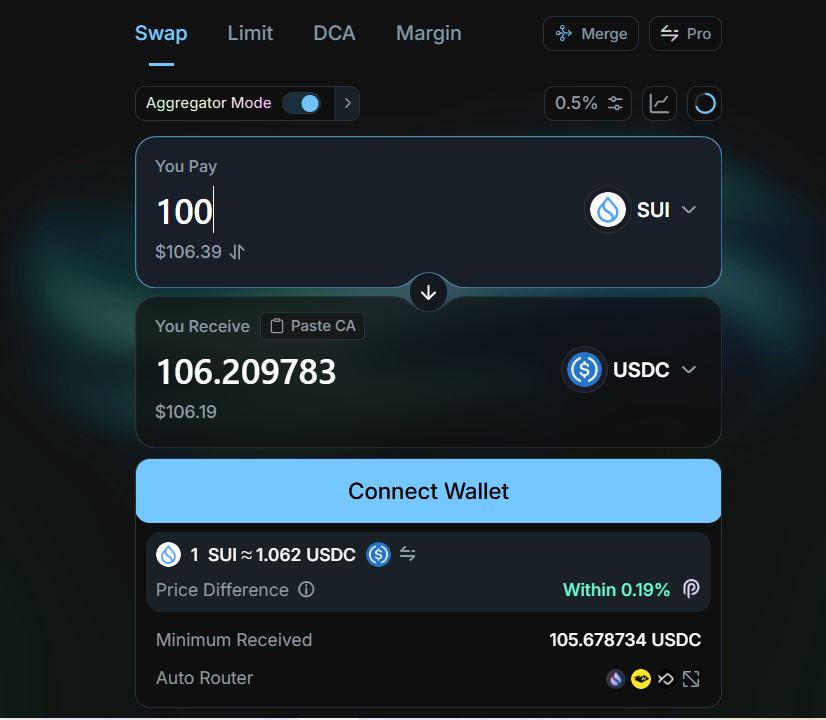
The importance here is straightforward. Every functional DeFi ecosystem needs deep liquidity, and Cetus provides the routing infrastructure that other Sui applications depend on. Without a reliable DEX aggregator, token swaps become expensive and fragmented, which kills user experience before it starts.
Cetus’s volume numbers suggest it’s achieving the kind of liquidity depth that makes Sui competitive with more established chains.
Community sentiment around Cetus is generally positive in terms of swap execution, though some users on crypto forums have noted that impermanent loss remains a concern for pool providers during volatile periods. The platform’s dominance does raise centralization questions within Sui’s DeFi stack, but its role as a liquidity backbone is difficult to overstate.
NAVI Protocol: Lending and Borrowing
NAVI Protocol is Sui’s largest lending market, with approximately $128 million locked at recent readings and total value locked reaching $723 million at its peak . The platform lets users deposit USDC or USDT to earn market rates or borrow against SUI holdings without selling them.
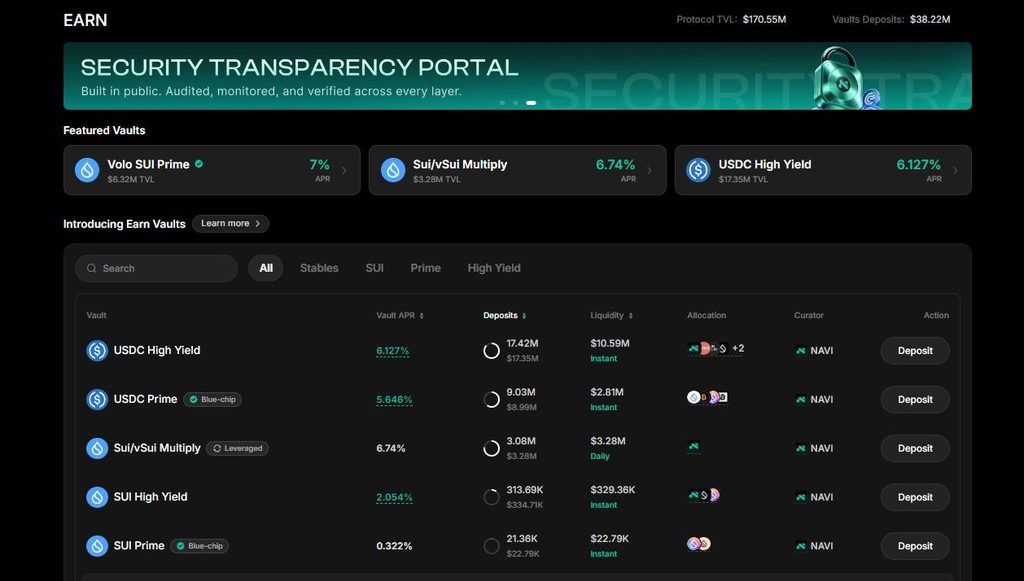
This is the kind of use case that separates functional DeFi from speculative DeFi. Lending markets provide genuine utility: they let holders access liquidity without triggering taxable events, and they give stablecoin holders a way to earn yield.
NAVI’s positioning as the largest lending protocol on Sui means it’s often the first stop for users looking to do something productive with their assets.
Reviews from crypto communities tend to highlight NAVI’s straightforward interface and competitive rates, though some users have expressed concern about smart contract risk inherent in any lending protocol. The protocol’s TVL concentration near the top of Sui’s DeFi rankings does create systemic importance, which cuts both ways for the ecosystem.
Bluefin: Derivatives Trading:
Bluefin is Sui’s busiest trading venue by transaction activity, handling $364 million in spot volume and $126 million in perpetual futures over a 30-day period . Users can trade at order-book prices or open leveraged positions on SUI.
Perpetual futures are where sophisticated traders live, and having a functional derivatives venue on Sui is critical for the ecosystem’s maturation. Without it, traders who want leverage have to bridge to other chains, which fragments liquidity and exposes them to bridge risks.
Bluefin’s volume numbers suggest it’s capturing meaningful trading activity rather than just existing as a check-the-box feature.
Reddit and trading forum discussions around Bluefin often focus on funding rates and execution quality compared to more established derivatives platforms. The general consensus is that Bluefin offers competitive pricing for a newer venue, though some traders prefer the deeper liquidity of centralized exchanges for large positions.
Haedal: Liquid Staking:
Haedal is Sui’s leading liquid staking protocol, with approximately $26 million staked through its platform . Users deposit SUI and receive haSUI, a liquid token that continues earning staking rewards while remaining usable in other DeFi applications like pools and lending markets.
This is a genuinely important innovation for capital efficiency. Traditional staking locks your tokens and removes them from circulation. Liquid staking lets you earn staking yield while simultaneously using the derivative token as collateral or liquidity. Haedal’s TVL suggests Sui users understand this value proposition and are acting on it.
The main risk with liquid staking protocols is smart contract vulnerability and potential depegging of the derivative token during market stress. Community discussions around Haedal typically acknowledge these risks while noting that the protocol has operated without major incidents to date.
For users who want to maximize yield without fully exiting their SUI exposure, liquid staking has become a standard tool.
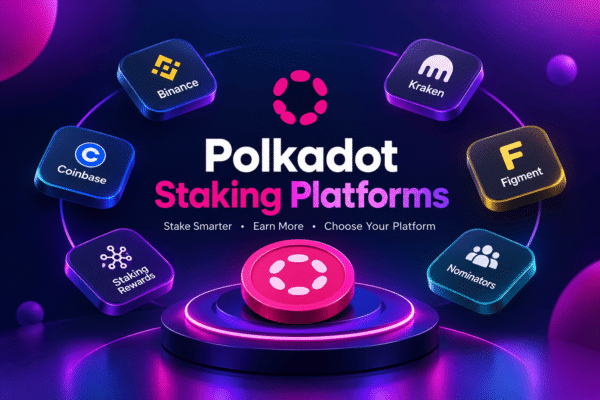
Explore: Polkadot Staking Platforms
Gasless Stablecoin Payments
The Samsung Wallet integration announced in October 2026 is arguably Sui’s most significant mainstream validation . Samsung Wallet selected Sui as its blockchain infrastructure partner to bring USDC to 82 million U.S. Galaxy devices.
Users can hold and send USDC directly through Samsung’s built-in wallet without paying network fees and without holding SUI for gas.
This is the use case that moves blockchain from crypto-native curiosity to everyday utility. Remittances connect over 1.3 billion people worldwide, and 41% of U.S. remittance users surveyed by Visa said they were likely to use stablecoins for international money transfers .
Samsung Wallet already handles payment cards, IDs, tickets, and digital keys for millions of users. Adding USDC transfers through Sui makes cross-border payments as simple as sending a message.
Sui has processed over $1 trillion in stablecoin transfer volume since August 2025, and the gasless transfer infrastructure means the network cost to users is literally zero . Adeniyi Abiodun, co-founder of Mysten Labs, framed it precisely: “Stablecoins have proven that dollars can move globally in seconds, but the next step is making that experience available where people already are” .
This integration’s importance for Sui cannot be overstated. It validates the network’s technical architecture at consumer scale and creates a pathway for hundreds of millions of mainstream users to interact with Sui without ever knowing they’re using a blockchain.
Sui’s Emerging Use Cases
Beyond DeFi and payments, Sui is being deployed in genuinely novel contexts. In September 2026, Daya integrated Sui as settlement infrastructure for gasless stablecoin transfers across Africa, targeting businesses that need efficient cross-border payment rails . DLP Labs is integrating the Sui stack to store EV data, with plans to tokenize carbon credits and virtual power plant revenues .
Perhaps most striking is Bhutan’s DHI InnoTech partnership with Mysten Labs on an offline blockchain project. The proof-of-concept demonstrated that Sui can operate in extreme real-world environments without internet connectivity .
And in academic research, IEEE published a study exploring Sui Move smart contracts for self-owned digital identity systems for rural farmers, addressing the problem of paper-based documentation that’s easily lost or damaged .
These aren’t speculative announcements. They’re working implementations that demonstrate Sui’s architectural flexibility beyond financial applications.
Understanding the SUI Token’s Role
The SUI token isn’t just a speculative asset; it’s the economic engine that makes these use cases sustainable. Gas fees, storage fees, staking rewards, and validator compensation all flow through SUI . The storage fund mechanism creates a deflationary pressure as network activity grows, because more data storage means more SUI locked into the fund and removed from circulating supply .
For users of the platforms covered here, SUI serves practical purposes. It’s the asset you stake to earn yield, the token you use for gas on non-sponsored transactions, and the governance asset that gives holders a voice in network direction. The token’s price decline in 2026 alongside record TVL suggests the market is still figuring out how to value infrastructure tokens relative to the usage they enable .
Sui’s Key Real Use Cases:
| Platform/Use Case | Function | Key Metric | Why It Matters |
|---|---|---|---|
| Cetus | DEX and swap router | $593M routed in 30 days | Liquidity backbone for Sui DeFi |
| NAVI Protocol | Lending market | $128M locked | Access liquidity without selling SUI |
| Bluefin | Spot and perps trading | $364M spot volume | Derivatives infrastructure for traders |
| Haedal | Liquid staking | $26M staked | Capital efficiency for SUI holders |
| Samsung Wallet + Sui | Gasless USDC transfers | 82M devices | Mainstream payment rails |
| Daya (Africa) | Stablecoin settlement | Gasless transfers | Cross-border business payments |
| Bhutan DHI InnoTech | Offline blockchain | Proof-of-concept | Resilience in extreme environments |
Conclusion
Sui’s real use cases aren’t theoretical. They’re processing billions in volume, settling stablecoin transfers at zero cost, and being integrated into hardware wallets that sit in millions of pockets. The network’s daily active address count near 1.2 million and cumulative transaction total north of 4.5 billion demonstrate genuine engagement rather than vanity metrics .
The SUI token’s role in this ecosystem is functional rather than decorative. It secures the network, pays for computation and storage, and creates deflationary dynamics as usage grows.
For crypto professionals evaluating Layer 1 projects beyond marketing narratives, Sui’s trajectory offers a case study in what happens when technical architecture actually aligns with user needs rather than theoretical benchmarks.
Frequently Asked Questions
What is Sui used for in real life?
Sui powers decentralized exchanges like Cetus, lending markets like NAVI, derivatives trading on Bluefin, and liquid staking through Haedal. Beyond DeFi, it’s used for gasless stablecoin payments through Samsung Wallet, cross-border business settlements in Africa, and experimental identity systems for rural farmers .
When did Sui launch?
Sui mainnet launched on May 3, 2023, with support from over 100 validators and more than 400 nodes .
What makes Sui different from other blockchains?
Sui’s object-centric data model and parallel transaction execution allow simultaneous processing of transactions that don’t conflict, enabling low latency and predictable fees. Its storage fund mechanism also creates a unique economic structure for long-term data storage .
Do I need SUI tokens to use Sui applications?
For most DeFi applications, yes. Gas fees are denominated in SUI. However, Sui’s gasless stablecoin transfer infrastructure allows supported applications like Samsung Wallet to sponsor transactions so users can send USDC without holding SUI .
What is the Samsung Wallet and Sui partnership?
Samsung Wallet integrated Sui as its blockchain infrastructure partner to bring USDC to 82 million U.S. Galaxy devices. Users can hold and send USDC through Samsung Wallet without network fees or needing SUI for gas .
How much value is locked in Sui DeFi?
Sui’s total value locked in DeFi reached an all-time high of $2.6 billion in May 2026, distributed across lending, trading, and leveraged products .
What is Sui’s storage fund?
The storage fund is a mechanism where storage fees from transactions accumulate in a pool that stakes itself and distributes rewards to validators. It ensures future validators get compensated for storing historical data and creates deflationary pressure on SUI supply .
Is Sui a good investment?
This article doesn’t provide investment advice. What the data shows is a network with growing on-chain activity, record DeFi TVL, and mainstream integrations like Samsung Wallet. The SUI token’s price declined over 70% in 2026 even as usage metrics climbed, suggesting market price and network fundamentals can diverge significantly .