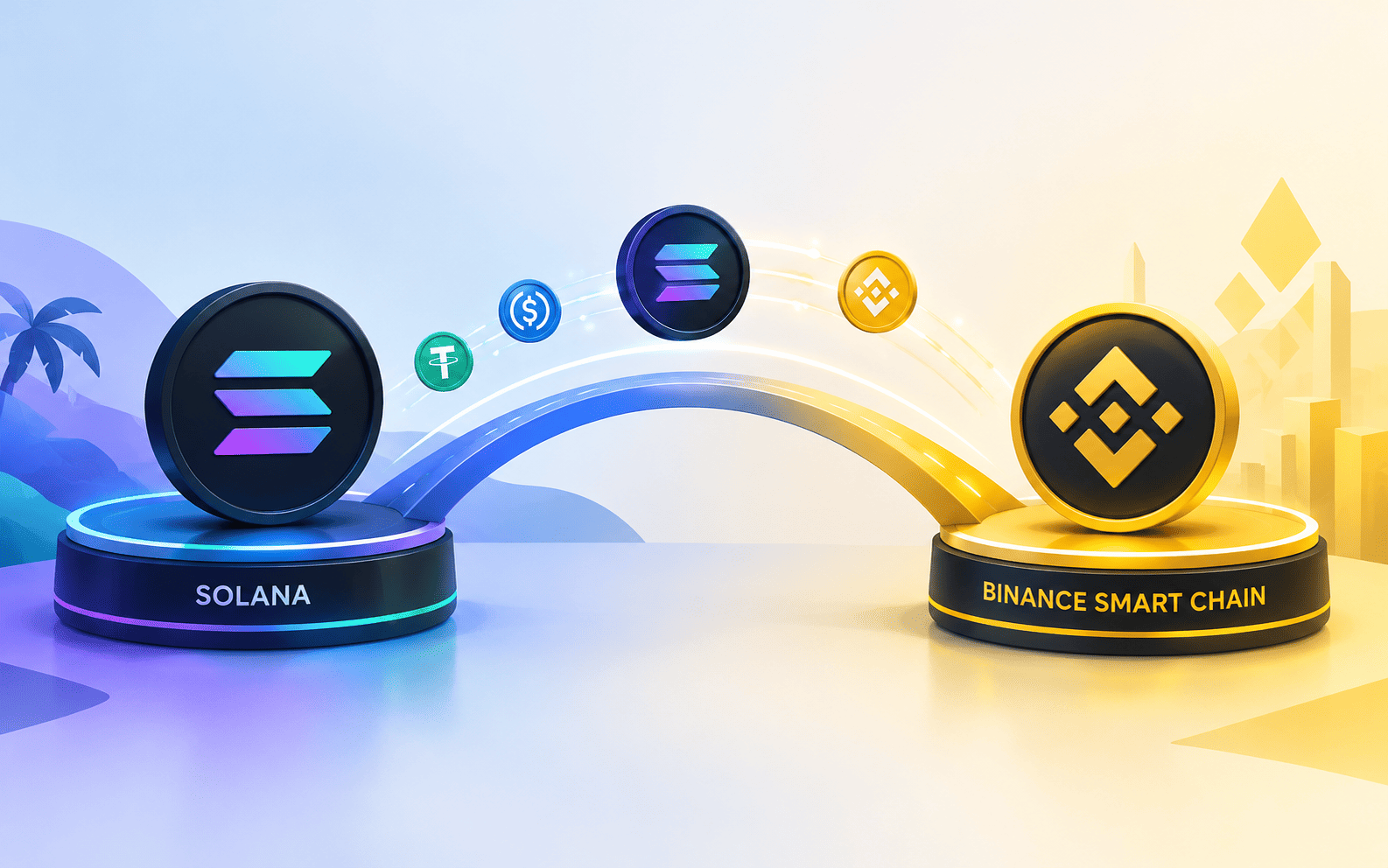
The transfer of assets between Solana and Binance Smart Chain (BSC) has come a long way since it was a cumbersome, manually intensive task back in 2021 during the bull market run. The ecosystem has advanced but also fragmented into a tangled network of bridges, aggregators, and intent-based protocols.
For the experienced user, the challenge is no longer if you can bridge SOL to BSC, but which route preserves the most capital.
This guide dissects the Solana-to-BSC corridor with the precision required for high-value transfers. We will examine the mechanics, fee structures, and the platforms that actually deliver native assets rather than wrapped IOUs.
The Bridge Overview:
Historically, bridging meant locking an asset on Solana and receiving a wrapped representation on BSC. This model, popularized by Wormhole’s Portal Token Bridge, creates fragmentation. You often end up with “Wormhole-wrapped SOL” on BSC, which has thin liquidity and may not be accepted by all dApps .
The industry has aggressively shifted toward native transfers and intent-based architectures. When you bridge SOL today, you want actual SOL on the destination chain, not a synthetic derivative.
This is achieved either through native token transfers (NTT) or through intent-based systems where “solvers” compete to front you the destination asset in exchange for a fee .
For the Solana-to-BSC route specifically, three categories of tools dominate the landscape: General-Purpose Bridges, Stablecoin Specialists, and Aggregators/Intent Protocols.
The Core Platforms for Solana to BSC Transfers
deBridge: The Intent-Based Standard
deBridge has emerged as the de facto standard for Solana-to-EVM transfers. It uses a 0-TVL (Zero Total Value Locked) architecture, meaning user funds are never pooled in a vulnerable smart contract. Instead, “solvers” fulfill orders in real time from their own liquidity .
When you initiate a SOL-to-BSC transfer, deBridge’s solvers deliver the BNB or BEP-20 token to your destination wallet almost instantly. You do not need to hold BNB for gas on the destination chain, a significant UX improvement that saves users from the “stuck in limbo” problem .
The fee structure is transparent: a flat fee (paid in source gas) plus a variable protocol fee of roughly 4 basis points (0.04%) and a taker margin for the solver . Reddit users consistently cite deBridge as a top-tier option for Solana-to-EVM routes, noting its speed and reliability .
Allbridge Core: The Stablecoin Workhorse
If your objective is moving USDC or USDT from Solana to BSC, Allbridge Core is the specialized tool. Unlike general bridges, Allbridge operates a liquidity pool model where each chain holds a native stablecoin pool. When you bridge, you deposit USDC on Solana and withdraw native USDC on BSC .
This model eliminates wrapped assets entirely for stablecoins. Fees are dynamic, typically under 0.3%, but they fluctuate based on pool imbalances. If your transfer helps rebalance the pool, fees are lower. If it increases imbalance, fees rise .
The tradeoff is clear: Allbridge is exceptional for stablecoins but does not support volatile tokens like SOL for this route .
Mayan Finance and Wormhole Portal Swap
Mayan Finance powers the next generation of Wormhole’s Portal Swap. By embedding swap metadata into Wormhole messages, Mayan enables one-click cross-chain swaps with low slippage .
For the SOL-to-BSC corridor, Mayan offers two mechanisms: Swift (intent-based, ~2-second settlement, no protocol fee) and MCTP (Circle’s CCTP-powered USDC transfer with a 3 basis point protocol fee) . Swift carries single transfers up to roughly $1M, while MCTP handles larger stablecoin volumes up to $10M .
The Wormhole Portal Token Bridge itself remains the infrastructure layer, supporting wrapped token transfers (WTT) between Solana and BSC .
However, for most users, accessing this via Mayan or the Portal Swap interface is preferable to navigating the raw bridge.
Fee Comparison:
| Platform | Primary Use Case | Estimated Cost | Settlement Speed | Native vs Wrapped |
|---|---|---|---|---|
| deBridge | Volatile assets (SOL, memecoins) | ~0.08% + flat gas | Seconds to minutes | Native |
| Allbridge Core | USDC / USDT | Dynamic, typically <0.3% | Minutes | Native Stablecoins |
| Mayan Swift | Fast SOL swaps to BSC | No protocol fee (solver margin) | ~2 seconds | Native |
| Mayan MCTP | Large USDC transfers | 0.03% (3 bps) | Minutes | Native USDC |
| Wormhole (Raw) | Any asset (legacy) | Gas + bridge fee | 15+ minutes | Wrapped |
Note: Fees are estimates as of early 2026. Always check the live quote before confirming.
Importance of Aggregators and Route Comparison:
The single most important piece of advice from the Reddit community is this: do not use a single bridge blindly . Liquidity conditions change block by block. A route that was cheap an hour ago may be expensive now.
Aggregators like Jumper, Bungee, and PancakeSwap’s Cross-Chain Swap solve this by querying multiple bridges (deBridge, Relay, Across, etc.) and presenting the best “delivered amount” . PancakeSwap, for instance, charges zero fees on its cross-chain swap feature, though you still pay the underlying bridge and trading fees .
For Solana-to-BSC, Jupiter’s Bridge & Swap feature is particularly relevant. It compares routes from GUM Universal Bridge and deBridge side-by-side, showing you the estimated delivered amount for each .
Trust Wallet and Mobile Bridging
Trust Wallet has integrated cross-chain swaps directly into its mobile interface, supporting Solana and BSC among 30+ chains.
The key advantage is self-custody: you retain your private keys throughout the process. Trust Wallet charges no additional service fee for cross-chain swaps; you only pay network and protocol fees .
However, user reviews on platforms like KuCoin suggest that while Trust Wallet’s same-chain stablecoin swaps are excellent (often with zero fees), the cross-chain bridge experience can be less transparent about the underlying route provider being used .
Note: For small amounts, this convenience is acceptable. For large transfers, verify the route manually.
Step-by-Step: Executing a Safe Bridge
- Verify the Contract Address. If bridging SOL, ensure you are interacting with the legitimate deBridge or Mayan contract. Scammers deploy identical-looking interfaces with malicious contracts .
- Compare Routes on an Aggregator. Visit Jumper or the BNB Chain Bridge aggregator to see the current best rate for your asset size .
- Check Destination Gas Requirements. Most modern intent bridges (deBridge, Mayan) do not require you to hold BNB on the destination chain for the initial transfer . However, you will need BNB for any subsequent swaps or DeFi activity on BSC.
- Execute a Test Transaction. If moving a significant amount, send a small test amount first. This is standard security hygiene in crypto .
Risks To Consider:
The primary risk with any bridge is smart contract vulnerability. While deBridge’s 0-TVL model reduces the attack surface, intent-based systems introduce solver risk. If a solver fails to fulfill the order, your funds are typically refunded on the source chain, but this introduces time delays .
Liquidity constraints are another factor. Mayan’s Swift method carries single transfers up to $1M; larger amounts require MCTP or splitting the transfer .
Allbridge’s dynamic fees can become punitive if the stablecoin pools are heavily imbalanced .
Frequently Asked Questions
You can bridge SOL directly using deBridge or Mayan. These intent-based protocols will swap your SOL to the destination asset (e.g., BNB or USDC) during the bridging process. You do not need to manually convert to a stablecoin first.
No. With modern intent-based bridges like deBridge, you only need gas on the source chain (Solana). The solver delivers the destination asset to your wallet without requiring you to pre-fund gas on BSC.
Mayan’s MCTP method, powered by Circle CCTP, charges a flat 3 basis point (0.03%) protocol fee and supports transfers up to approximately $10 million. Allbridge Core is also competitive for stablecoins, but fees are dynamic.
Intent-based routes like Mayan Swift settle in as little as 2 seconds. deBridge typically settles in seconds to a few minutes. Legacy wrapped-token bridges (Wormhole raw) can take 15+ minutes due to finality requirements.
PancakeSwap itself does not charge fees for cross-chain swaps and routes through audited partners like Across and Relay. The safety depends on the underlying bridge. For SOL-to-BSC, the route uses Relay, which is a reputable intent protocol.
With intent-based systems like deBridge and Mayan, if the solver fails to fulfill the order, the transaction is refunded on the source chain. There is a timeout mechanism. With wrapped-token bridges, funds can be stuck if the destination transaction fails due to gas issues.
Yes, deBridge supports a wide range of Solana SPL tokens for cross-chain transfers to BSC, depending on available solver liquidity. Jupiter’s bridge interface allows you to search by token contract address to see availability.
For some users, a CEX is cheaper and simpler. You deposit SOL, sell for USDT, buy BNB, and withdraw to BSC. However, this requires KYC and exposes you to custody risk. On-chain bridges preserve self-custody and privacy but may cost slightly more for small amounts.